

Bevano
Lago Maggiore, Piedmont, Italy

I’m in a tiny town in Italy you’ve never heard of– Bevano– on the shores of Lago Maggiore, about an hour and a half northwest of Milan. We are staying in an apartment several hundred feet from the lake, and I arise early as is my habit and try to slip out without waking my wife, who sleeps on her side with the sheets bunched, revealing her bare foot, ankle, and right leg up to the knee (I have to bodily resist wrapping my hands around her ankle to feel the warmth of her skin, the call-and-response of touch, but I don’t want to wake her), and my daughter, asleep on the foldout sofa on her back, her hair arrayed about her sleeping face.
I make my way out a series of doors locked with progressively more and then less ornate keys, down to the cobblestone street. It is just before dawn, the mountains across the lake are haloed by anticipatory luminescence. Just across the road from our apartment, a hundred yards, is the old church. Last night, returning from a late dinner, the illuminated vault, visible through a round window, caught my eye: it looked to be filled with mosaics of astonishing beauty.
And so I come around the front of the building, climb the steps, and find myself standing at the end of a long portico, the pediment of which could be Greek or Roman, which contains a series of frescoes of the stations of the cross.
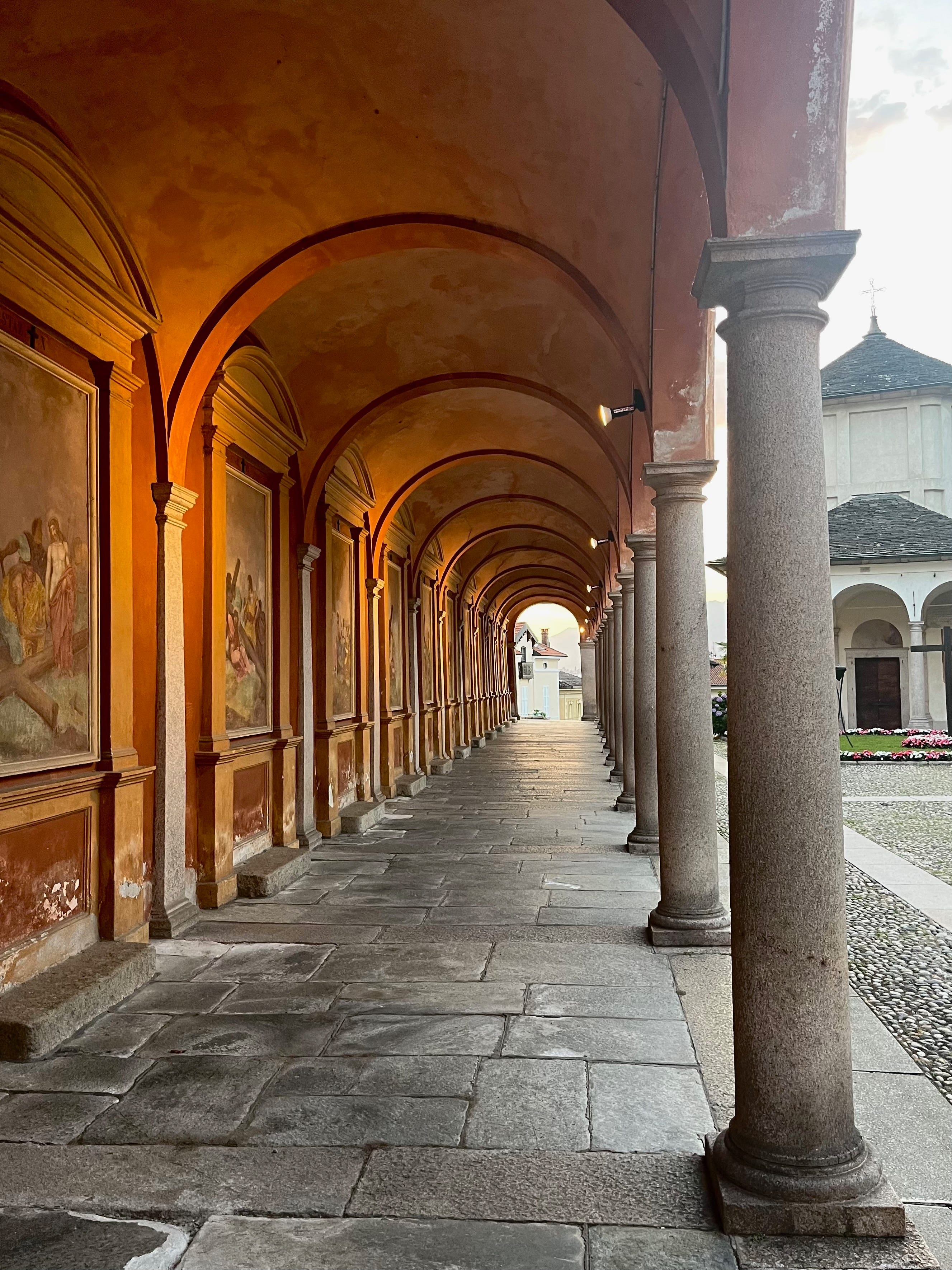
Unless I’m quite mistaken, neither you nor I have ever heard of the painters of these frescoes. This is not, to my knowledge, a church of great renown. Yet the technique is fresco undoubtedly; you can tell by the quality of color and the crystalline flecks embedded in the surface.
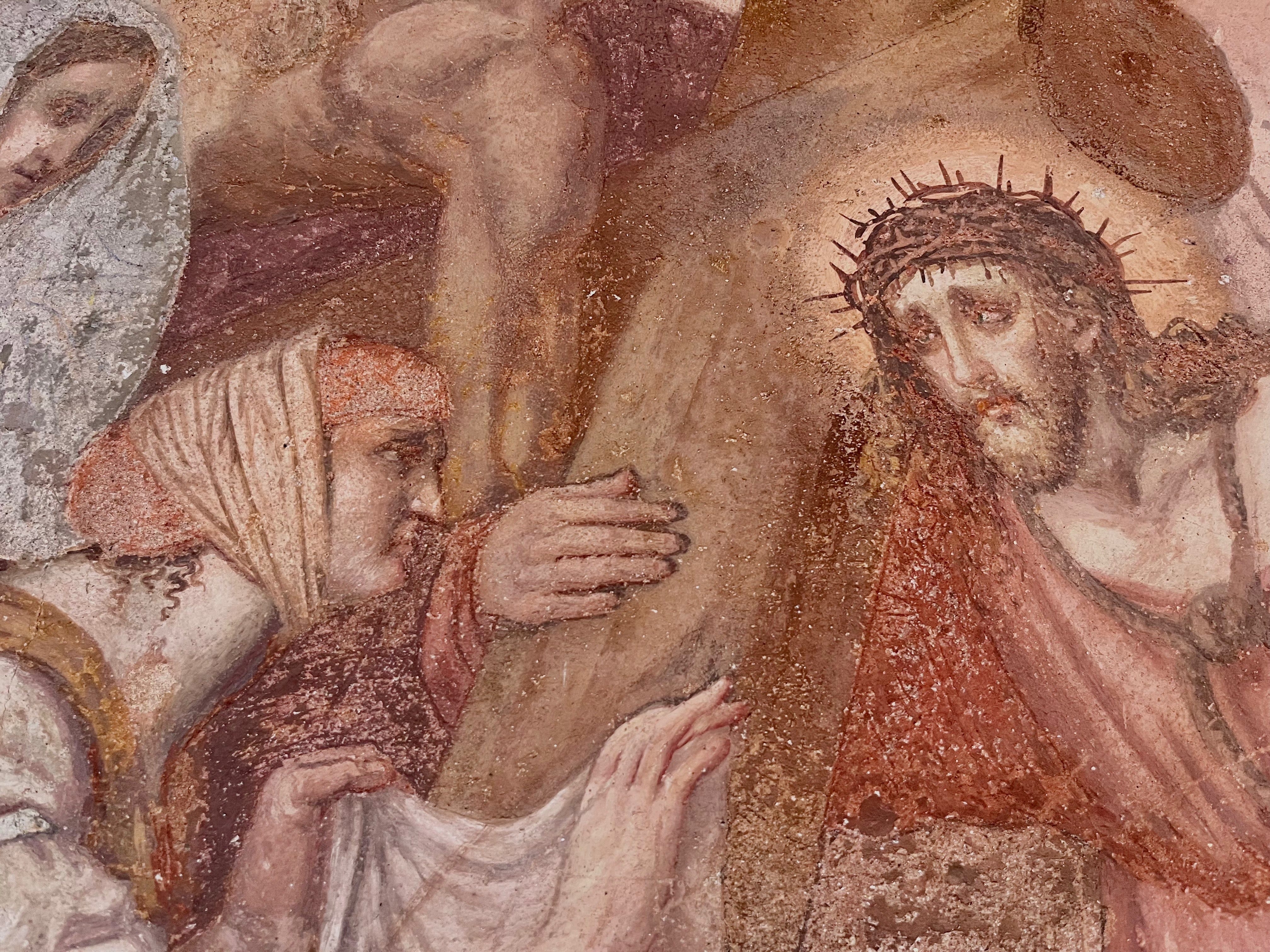
The emotional expressivity of the imagery is so great, the pathos and beauty, the articulation of the hands, which owes its form directly to the High Renaissance although I have reason to believe that these frescoes were made in the past hundred years– it is so extraordinary I find myself moved to tears.
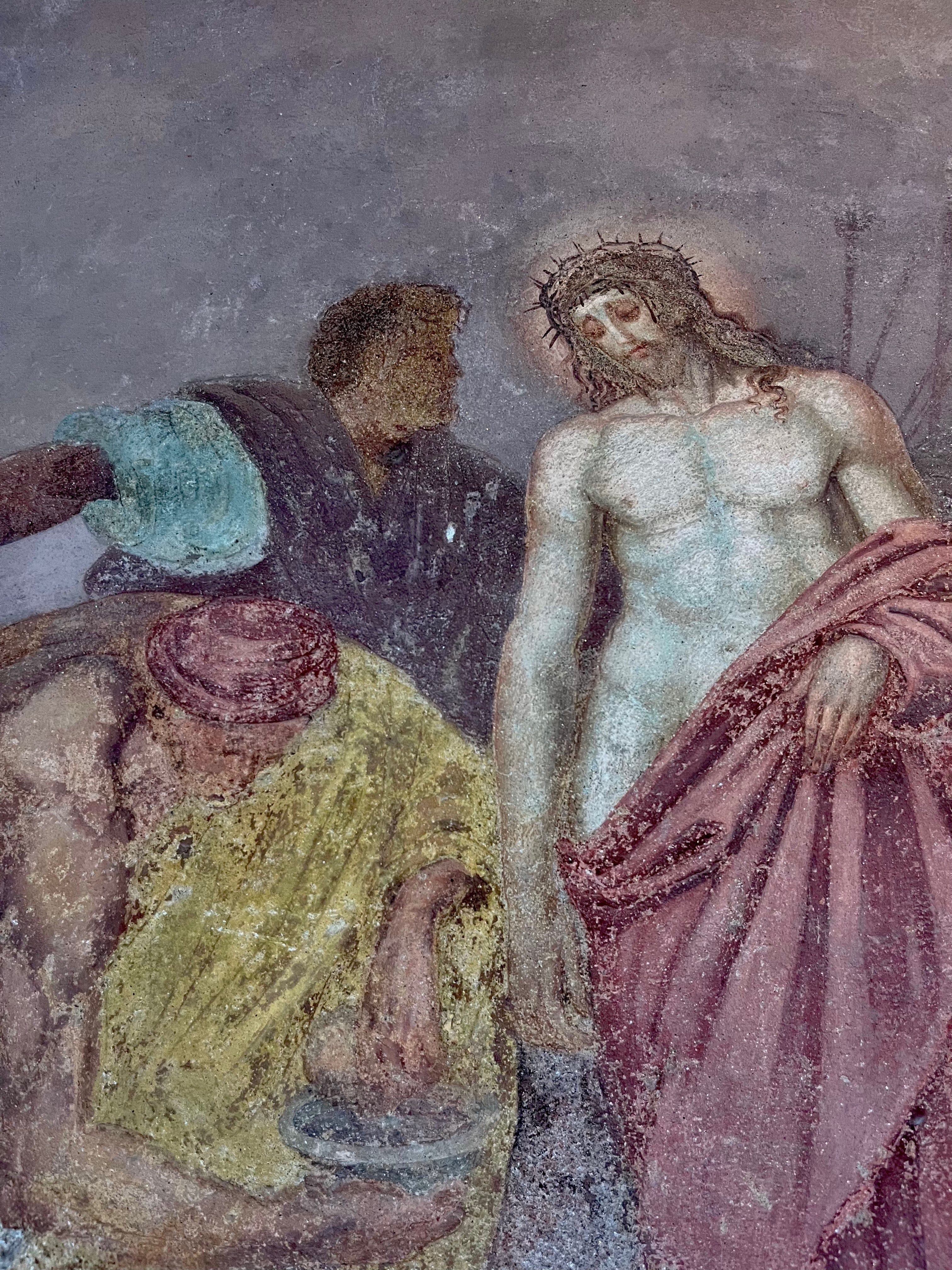
In the penultimate panel, the representation of Jesus, no longer clothed, his body glowing with a luminescent and slightly otherworldly greenish hue, is so anatomically perfect that I am rendered speechless. I have lost all anchoring outside of the painting: I have fallen in. I am helpless, overcome with emotion. The painting has simply taken me.
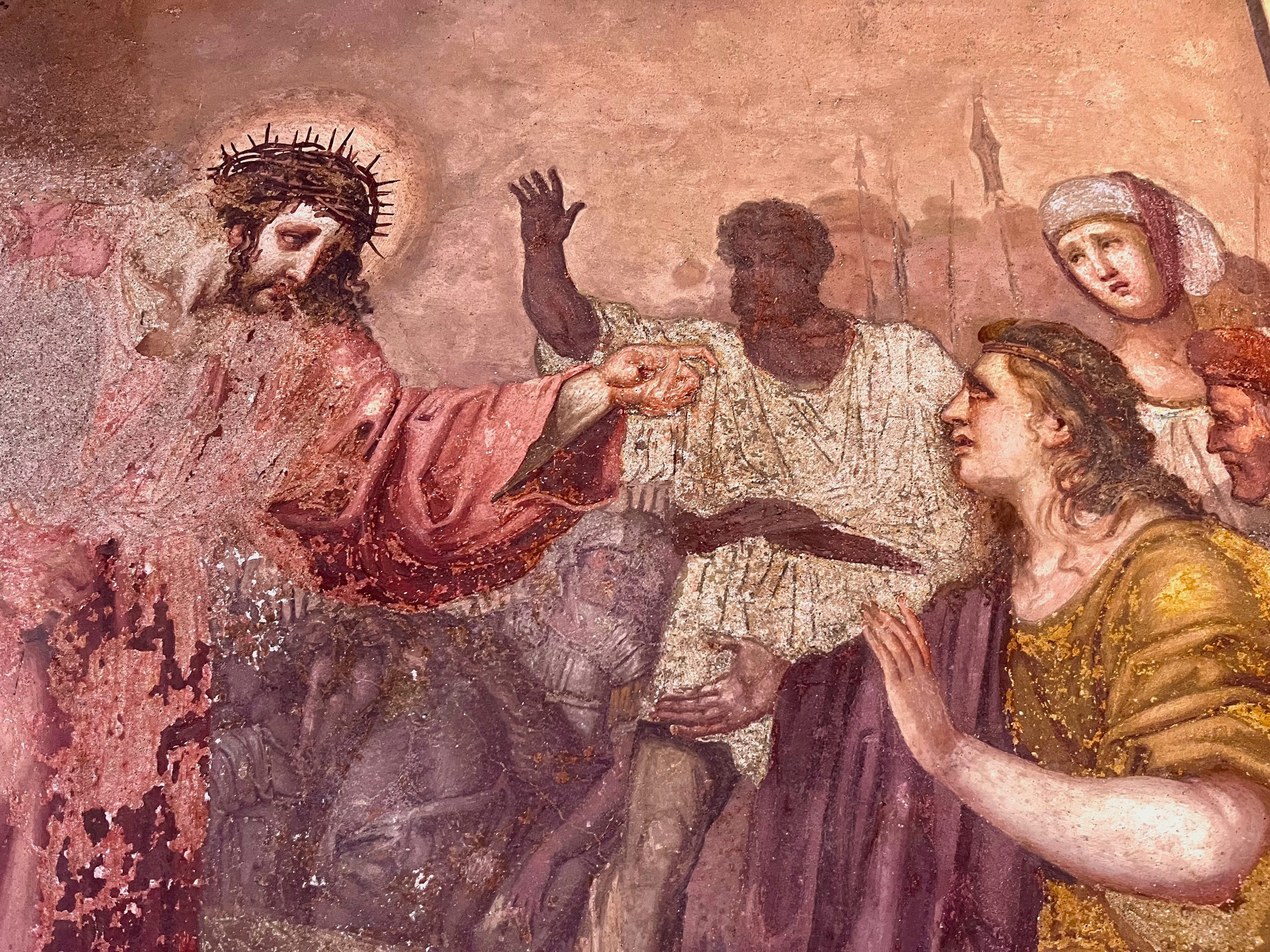
At station XII I am slain. I am nowhere, in a tiny church in a remote corner of Italy, and the image of the crucifixion is the most powerful I have ever seen. The artist has triumphed: my distance has been removed; I am transported. I kneel at the foot of the cross. I cannot help it: it seems the only appropriate response.
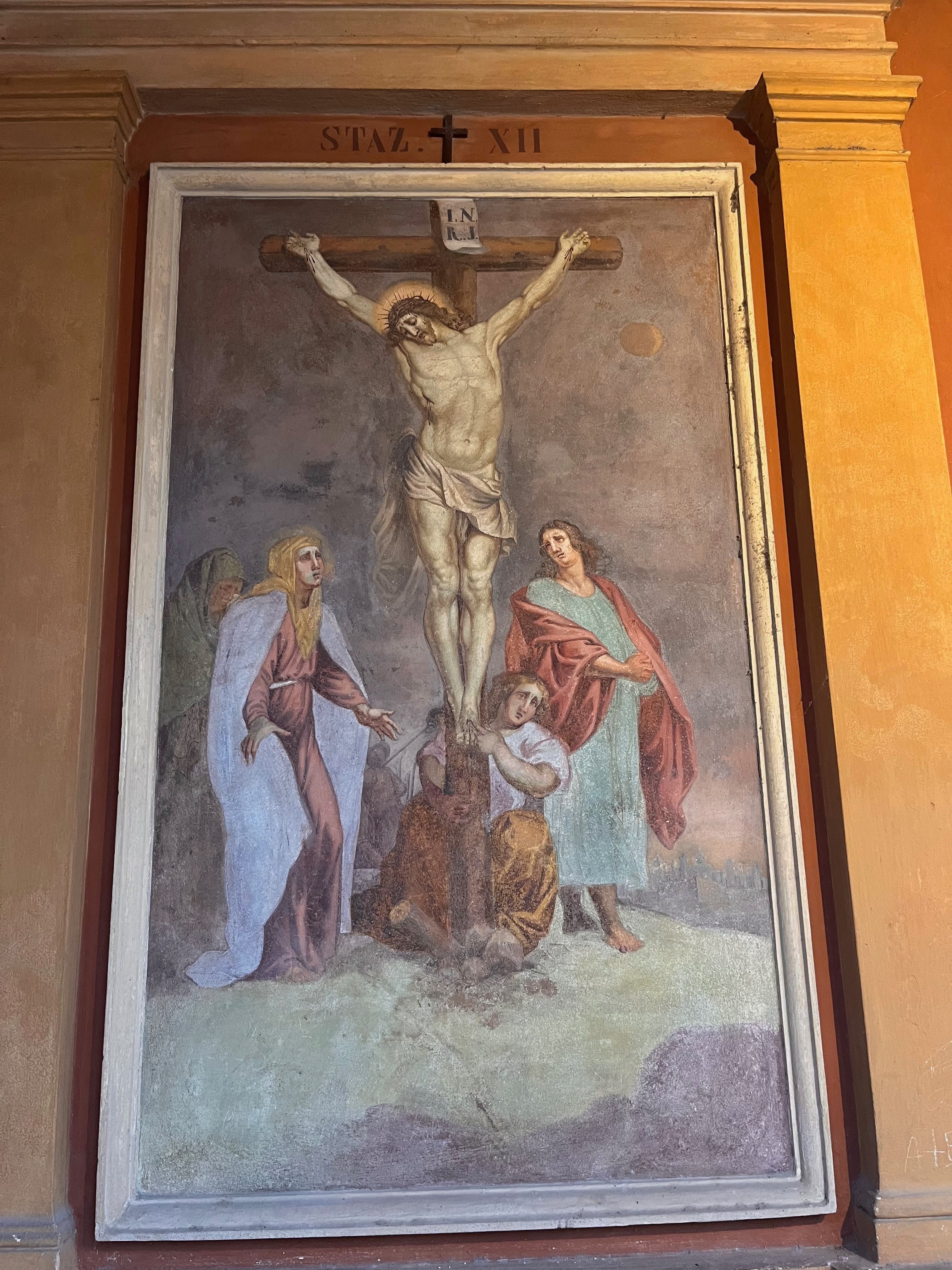
I would propose to you that there is something about what the paintings do, as opposed to what they mean, that importantly subverts our received narrative about them. While the church was arguing back and forth about the corporeality of the body of Jesus, affirming its difference from our own, the images land the body in its beauty in our bodies. Think what you want– there is a direct transmission in the images independent of ecclesiastical interpretation. We can talk all day long about what the story of Jesus means, but there is something that the paintings do. They act upon you. Upon what it means to be you, the viewer, wearing your own body. Like an ornate key slotted into the locked door we did not know that we are, the paintings open the body. His body, and through some kind of affinity, the visual and neurobiological mechanism of which is yet opaque, your body. Beauty, like the swallows whistling and knifing through the dawn, cannot be kept out of the church. It enters.
I’m not saying the Italian Renaissance invented beauty; I’m saying something more nuanced, but also possibly more radical. In the same way that an infant comes to experience their own interiority by the quality of attunement and reflection a caregiver gives them– in this sense we do not self-regulate, but rather we co-regulate based on the caliber of neurological inputs that we receive from primary caregivers: this is the basis of attachment theory– I’m saying that we do not truly grasp, collectively, the magnificence of the human form in its relationship to the Divine until Leonardo and Michelangelo show it to us. This bodily registration of the magnificence then becomes part of us. In this way these drawings, frescoes, and sculptures do not simply reflect us to ourselves, for this would be to show us something that we can already see. Rather, they invent how we see ourselves. They invent our bodily registration of this relationship.
I’m not sure that I can adequately explain how important this becomes to the next several hundred years of cultural development. The compounding effects of innovation are hard to anticipate. The first car, the first plane– these are essentially miracles of innovation. I remember early plane rides as a small child, the sense of absolute wonder as we broke through the clouds (it is raining down there) into the atmosphere above, the startling robin’s egg blue of the sky, the silence of the cabin. Truly these machines transform not simply the way we get around, but how we experience the world. Yet today, with their proliferation, their dominant form of generating power (combustion of fossil fuels) the very proliferation of the inventions threaten the terrestrial ecosystem. So it is as well with this invention of representational visuality. In its individual unit of occurrence it is a miracle that opens us to ourselves: become the de facto way of knowing the world it arrives at a hegemony of visuality that blinds us to as much as it reveals.
Across the duration of the High Renaissance, vision, as a means of knowing the world, accretes to itself a sort of confidence born of the representational wizardry developed by Leonardo, Michelangelo– all the painterly ninja turtles of Florence- that it does not rightly deserve.
With the development of linear perspective, techniques of foreshortening, the anatomical studies that broke into the body to understand its underlying mechanical structure, close studies of the expression of emotion through the face and body– a level of realism emerges on the two dimensional surface that tricks the eye. Because it is devoted to such noble ends– statistically the predominant Renaissance painting subjects are certainly Jesus and the Virgin Mary– and because the faces, hands, bodies, postures, scenes depicted are so deeply resonant with emotion, faith, yearning– they come to be indistinguishable from our experience of our place in the world. Remember that during this period of time most people didn’t read. Immersed as they were in the stories of the Bible, they could not read them, and as such they could not necessarily visualize them inwardly, which is part of how we partake imaginally in the stories themselves. To be able to see the stories rendered visually, in their glory, with the colors imbued into these frescoes: aquamarine, magenta, azure, spanning the vaults of Renaissance churches, was to be transported into the stories.
Yet these are techniques that collapse a three dimensional reality onto a two dimensional surface. They encode an illusion of depth that although accurate is in fact a tiny fraction of what we can see if we are able to use the eyes to experience volume. It is thus that in the same stroke they invent our experience of the world around us, and our place in it, they foreclose it.
In order for you to understand viscerally what I am saying, a brief exercise is in order:
