

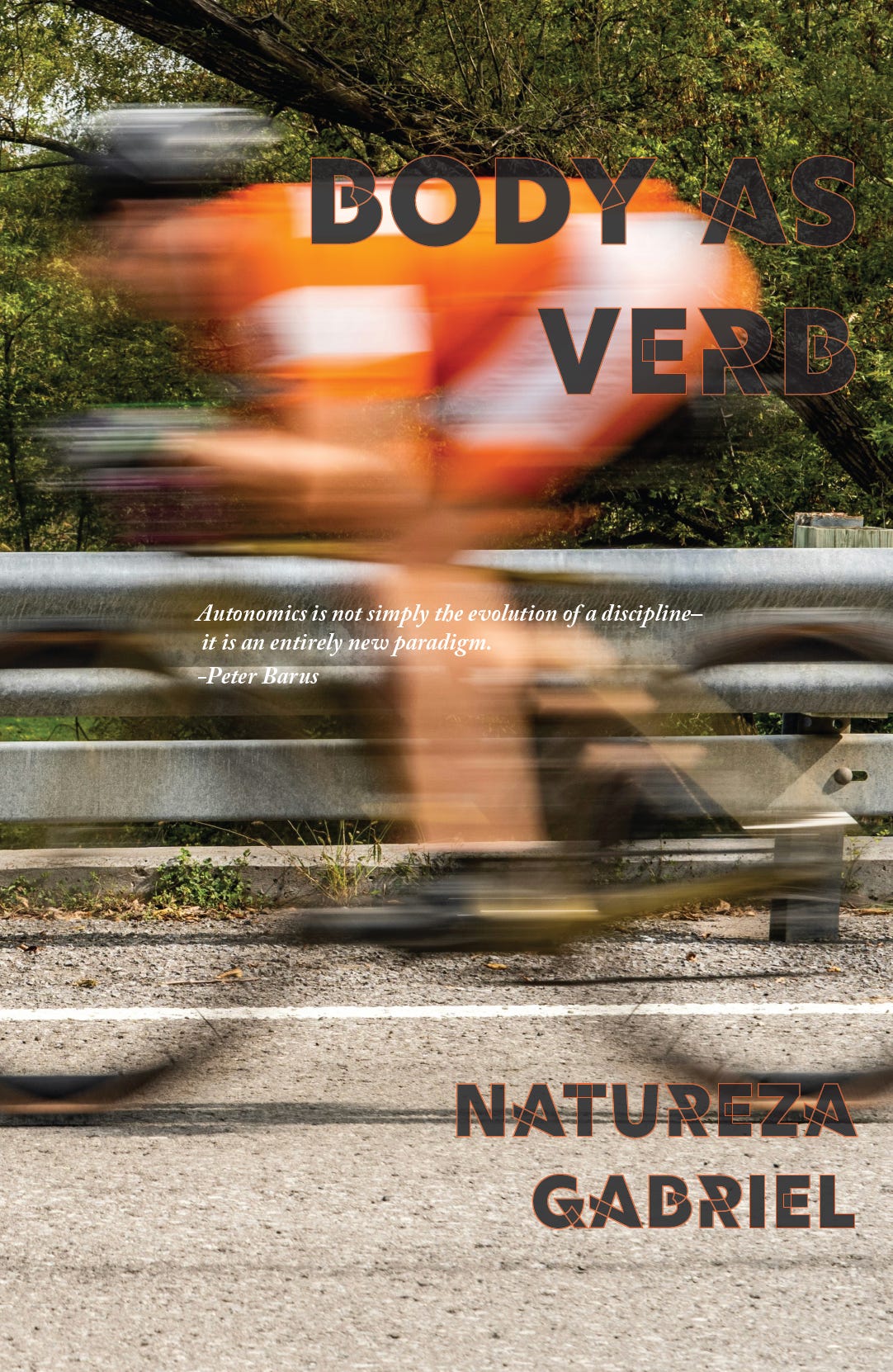
Body As Verb
The third book in the Autonomics Trilogy

01
Biology. Bio. Logos. The study of life. Biophilia. Bio. Philia. The
loving of life. Biobios. Bio. Bios. The living of life.
In Tzutuj’iil Mayan, N Kasea. To live. Literally, the ember yet
burns. Smouldering, potentially other-igniting, this ember,
which is us, yet burns. To burn is to combust, and to be in
motion.
Old Lakhota, a two-hundred-thousand-year-old language
aboriginal to Turtle Island, the prosodics of which sound like
the earth singing, is described by one of its speakers to me as
a non-mathematical quantum mechanical language of intuition. A
verb-based language, it describes the motion of energies. The
language has no word for ‘I’.
We moderns concretize a sense of self: we attempt to reify it, solidify
it, make it Newtonian. Turn it into a thing. We attempt to
turn a verb into a noun, because we want to capture something,
enclose it, own it, possess it. Make it ‘mine.’
This is like trying to own the wind. Let it go. It is an attempt to
catch water in your hands. Water is life; it spills right through
your fingers. What you be is in motion, animated by an entelechy
that pervades animacy, a source frequency of which the
ordinary sense of self we attempt to localize, reify, concretize
and own is merely derivative.
What would it mean to have a more fluid sense of self, or better
yet to release it all together: to release the compulsion to name
it, to accrete a solid sense of identity?
What would it mean to allow ourselves to return to a more
primal and limpid flux, to permit ourselves to be water, to be
embers rising on the wind, to release the contracted ‘I’, to open
ourselves to the notion that life itself is something moving
through us, to become the flow itself, to realize that I move,
therefore I am.
ARRIVING LATER THIS YEAR…