

Bologna
Porticos and portals to the inner life of place

To be in an old European city – most of them are old - is to be transported, both temporally in obvious ways: when you are walking through buildings that are five hundred, seven hundred years old you feel this in the architecture, its style, materials, and manner of construction, the wearing of the flagstones over whom feet have passed for so many generations, in the widths of the streets which were designed for the transverse passage of two horses’ asses (the gauge on a railroad is based on the width of a horses’ ass, if you didn’t know). Medieval streets were wide enough for two of them to pass in opposite directions, a width perfect for one and a half cars. (Therefore most of these are one way- if people ignore the signs and two cars face off it gets pretty interesting, especially if they are men who both know the dimensions of their cars with great precision and think that they can magically make them narrower if they curse in a precise incantatory manner).
The temporal displacement is also subtler, something in the air; an altered sense of time. There is something about being in a place so much older than you that changes the bodily registration of the length of a human life, and perhaps therefore the rhythm at which we proceed. I cannot help but feel it, which I know because I am jarred at the periphery of these old cities, when this temporality is contested by modern materials and people and cars moving at modern velocities.
There is also then something of the particular, obviously, about each city. These are deeply rooted in place: their geology, agricultural and cultural context. Most of them are old…date back to the Romans at least. In Bologna the perimeter fortifications of the city are Etruscan; the bricks 2500 years old.
I’m in Bologna now for the first time: home of the oldest university on earth. The University of Bologna was founded in 1088 AD. It was originally a universitas magistrorum et scholarium, which translates roughly as ‘community of teachers and scholars’: a scholars guild, a union. The word which we use, university, originally referred to guilds or corporate bodies of students and masters, derived from universus (meaning "all taken together" or "entire"). I’ve only been here a short time– long enough to arrive from the train station in sweltering heat, collapse on the bed, take a shower, walk out into the scorching afternoon, be astonished by the quality of italian tailoring and then italian prices, circumambulate my wife and daughter while they shopped for a swim suit, duck into a church (magnificent, dark, somber), gorge in a trattoria, walk home, go to sleep, dream of conflict, wake early…
My impression thus far is that Bologna is a city of porticos. They are everywhere, covered understories of buildings that carve a sort of network of almost tunnels in twin parallel lines along most streets in the old city.
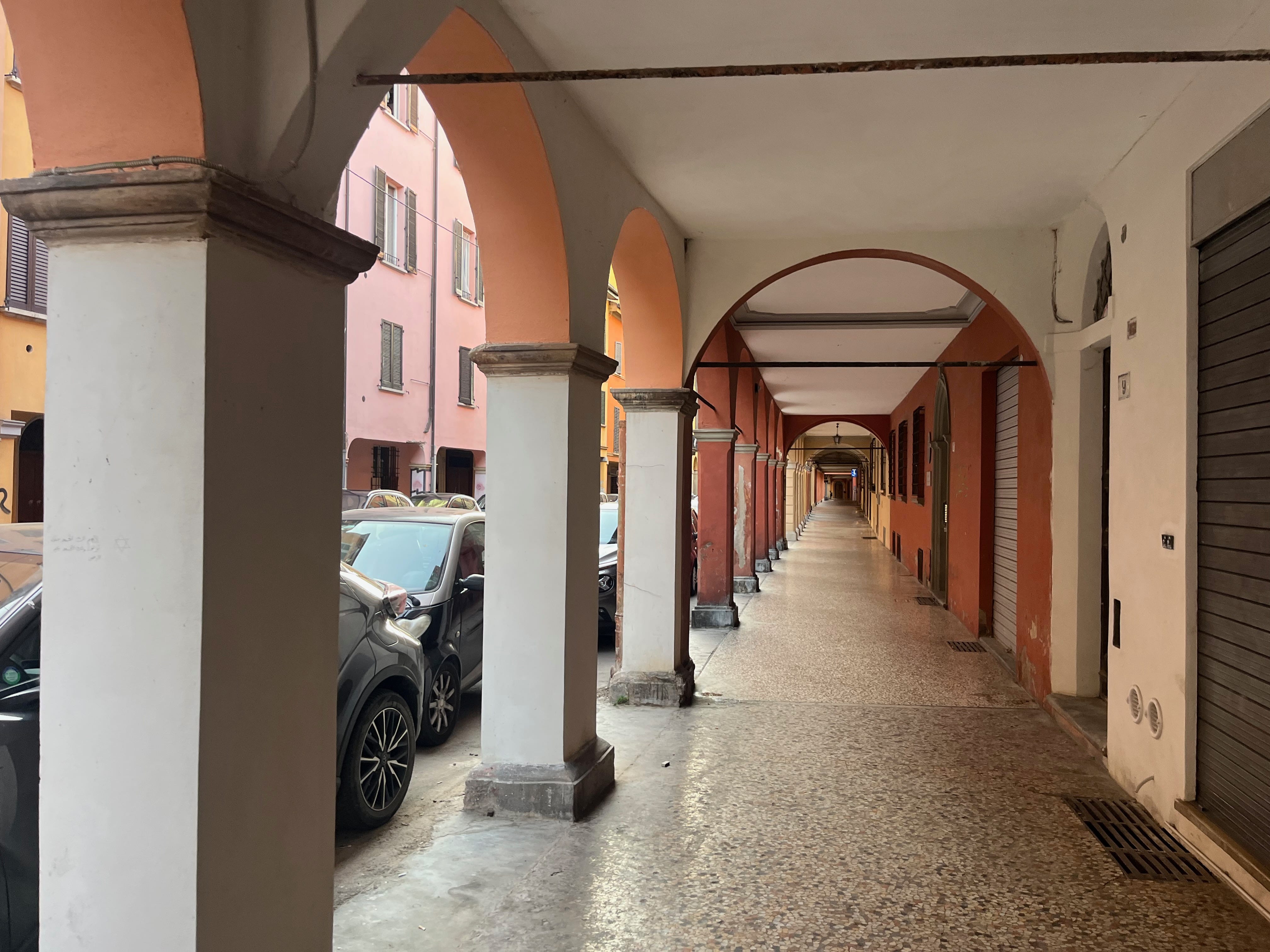
In a city of porticos, there are then furthermore two things that call your attention strongly. That would be doors– etymologically linked to porticos in Italian though not in english (portico ita - portico eng), (porta ita - door eng)…
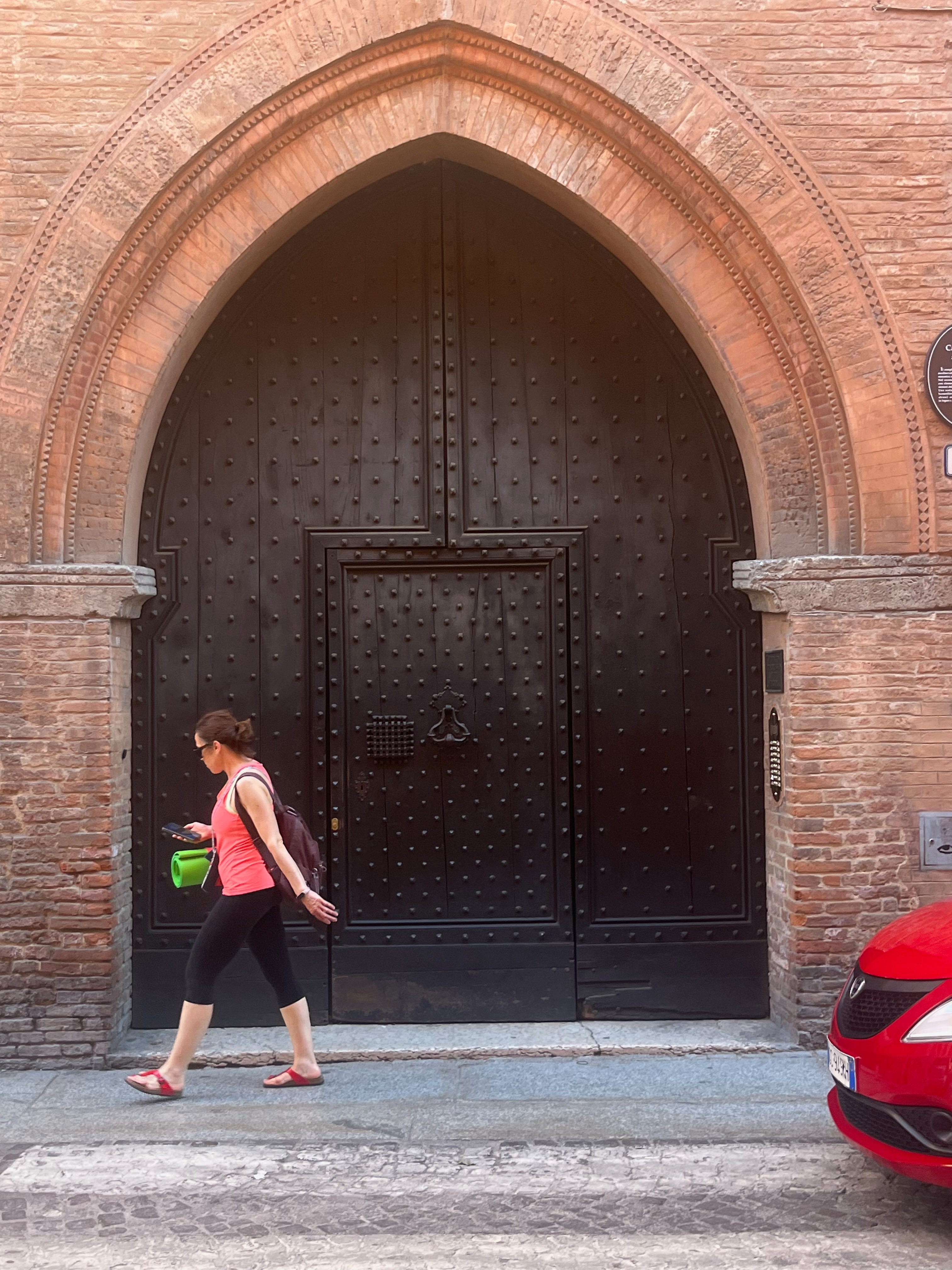
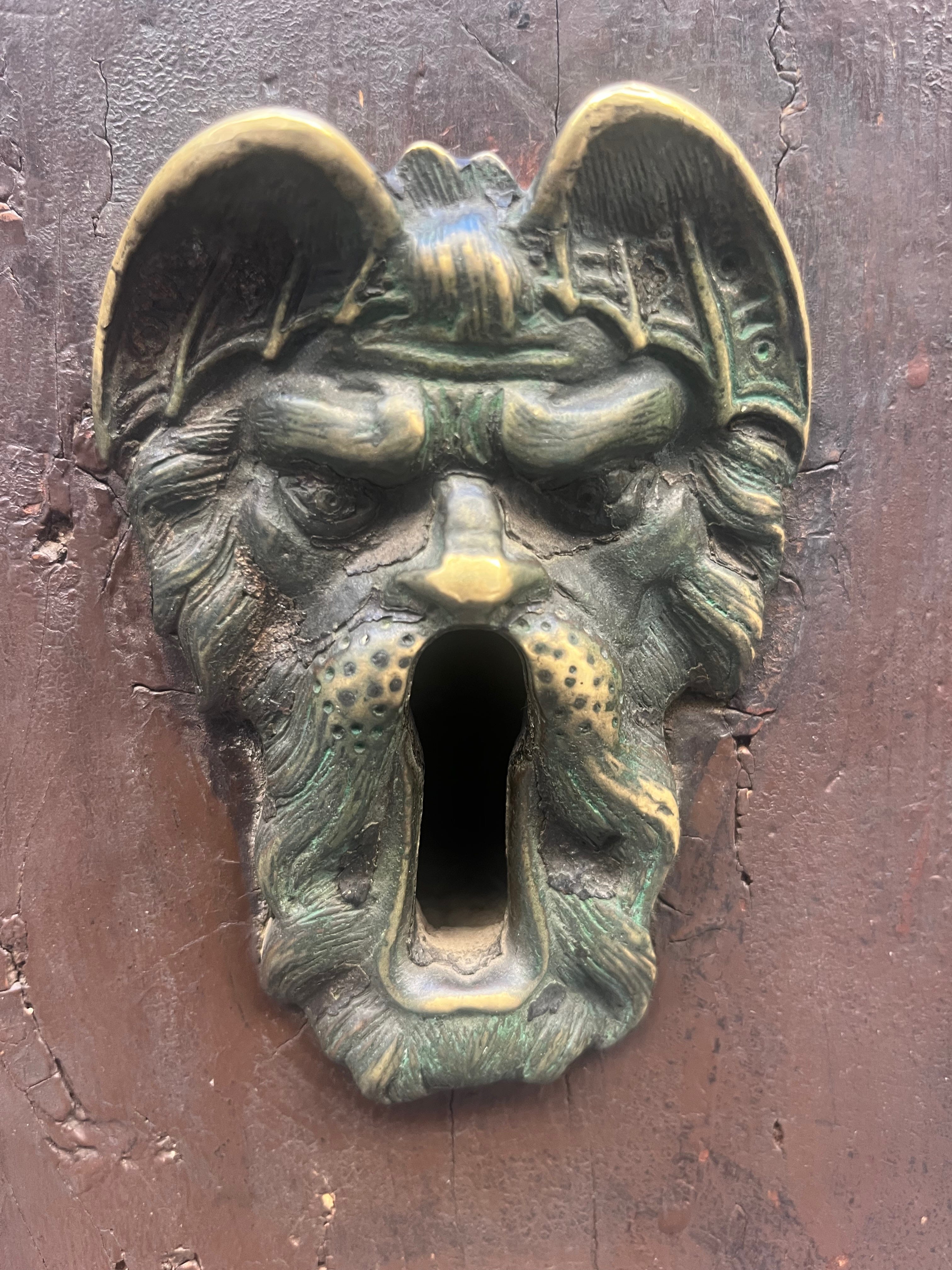
And then the handles that open them, of which there are more magnificent (and very strange) here than anywhere I’ve ever seen. Bologna is, apparently, quite famous for its doorknockers, and deservedly so…battiporta (door knockers) and picchiotti are everywhere and of all description.
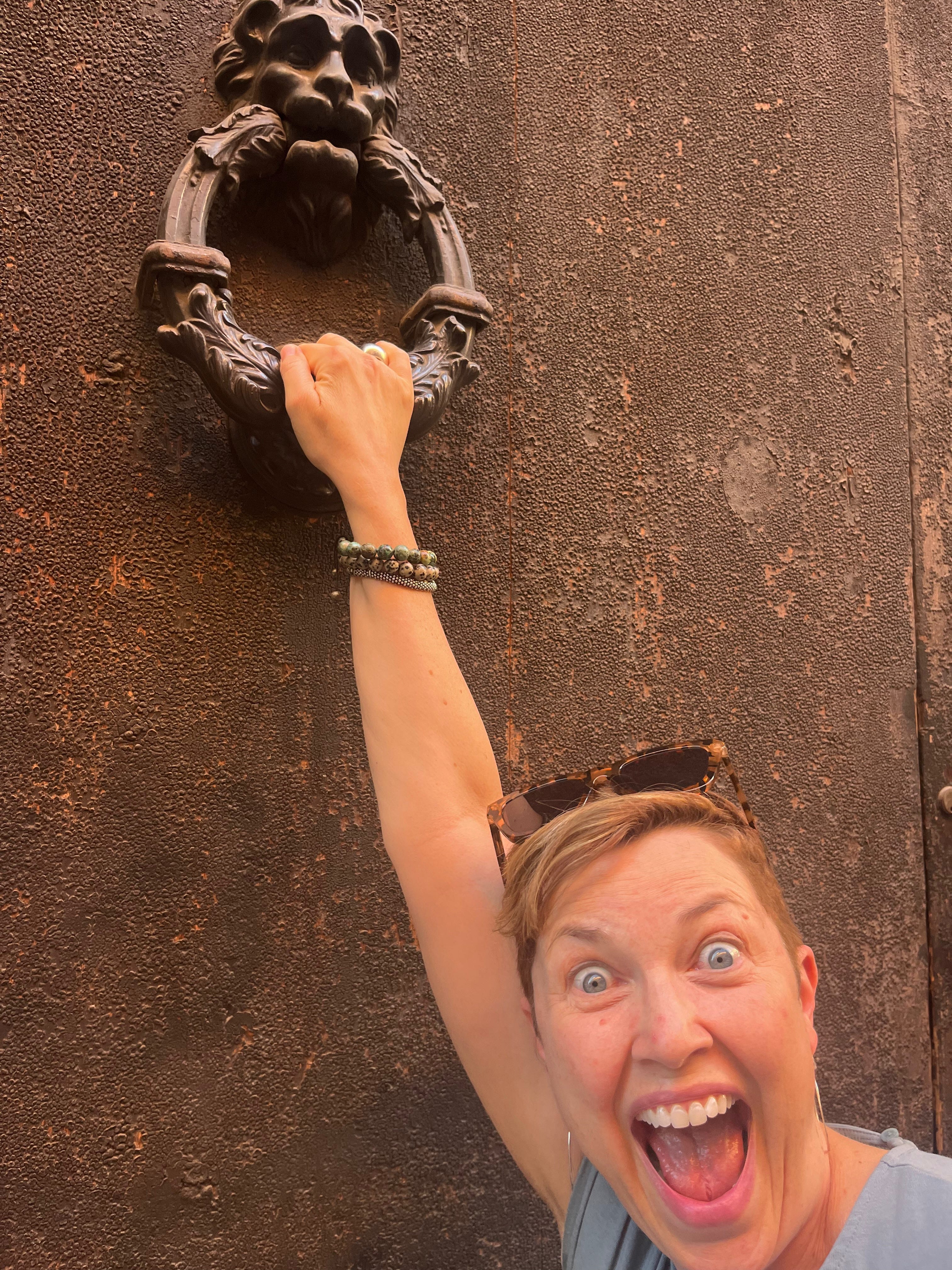
My wife made this face spontaneously upon grasping the affiliated knocker– I hesitate to gloss it autonomically; I’m not sure if she’s being electrocuted or exhilarated, there didn’t seem to be any enduring ill effects.
The net effect of all of this portico walking, which is shaded, but has a bit of a subterranean feel, while the buildings are brightly colored yet largely earth-tone, betwixt and between fabulous structure, in a city filled with gas and diesel vehicles and a population that likes to smoke and will out of consideration step out of a restaurant and into its open door to smoke outside (WTF? Ever heard of a thing called wind?) and the sensory and inhaled texture of Bologna is not like anything I’ve ever experienced.
