

Firenze
Day the First

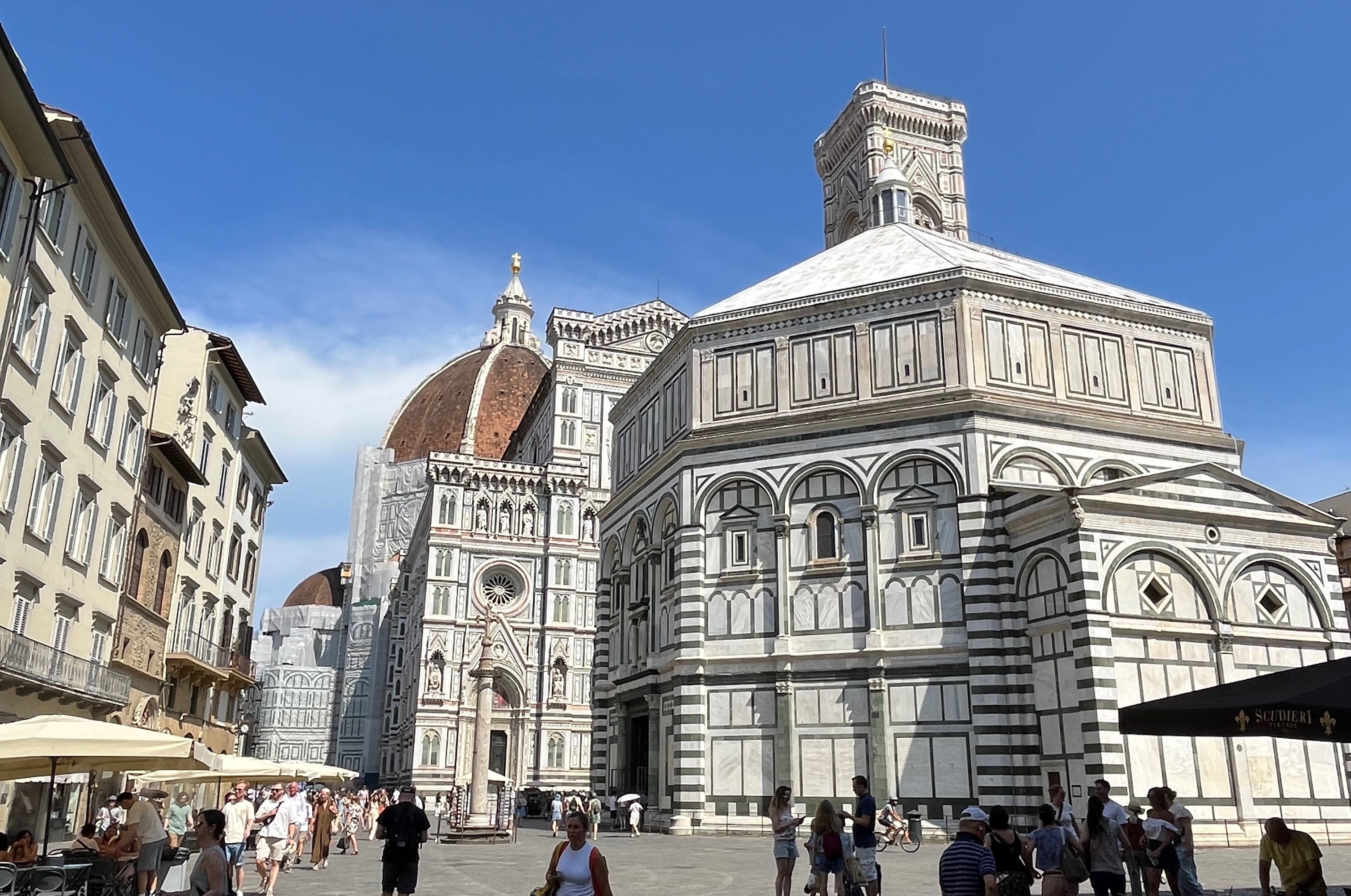
Florence Day One
It takes me about three hours after seeing the Florentine Pietà to realize that I have entered a fugue state– of aesthetic rapture– in which I have been revolving without recognition, perambulating like a gobsmacked child– and that in an unconscious attempt to ground myself in its wake…I have turned to shopping for books, paper goods (?), linen napkins (?), fashionable men’s clothing in three different stores, food, news…
I realize, in a specific moment of scrolling through the news feed on my phone– what the actual fuck am I doing? - that I am attempting to distract myself from this state because I don’t know what to do with it. I left the museum high. The visit has done something to me. In a totally altered state; a sort of aesthetic bliss, moved to the core, buoyed, carried up and in and out simultaneously I have been wandering around Florence looking for something... Transported. I don’t have a word exactly for where I am now.
It happened like this. I was in the museum bookstore, and saw a book about Michelangelo’s Pietà, and I picked it up. Because it was not the Pietà that I have seen photographs of numerous times; the one in Rome, at St. Peter’s; the one I’ve written about; the one my friend Jeffrey saw as a child that moved him so; the one with Mary much larger than life, younger than she would have been; the one he made when he was twenty-three and signed, when his career was just beginning and he, we, none of us knew exactly who he would become, regretting it ever after, swearing not to sign another work of his hands (he did not).
And so because I did not recognize the sculpture I thought that the writer of the book was the sculptor of this other sculpture, and yet I could not stop staring at it in the pages. There were perhaps 25 plates in the book; each one more compelling than the previous; all in black and white. This happened around 4:30 pm. Then I went up in the bell tower. And then, on the way to pick up the backpack I had deposited (no backpacks in the bell tower) I passed in front of the Museo dell’Opera dell Duomo di Firenze, and wandered in. In the third room I found myself standing before it.
A little bit like wandering into the forest, following a trail, and suddenly emerging into an opening filled with hallowed light into which some feature of nature– a waterfall let us imagine– of such unexpected astonishing beauty comes into view that you cannot stop staring. I shook myself. It felt a bit like coming up from under water.
Time broke.
It was lit from above, on a large pedestal such that the base was chest high. You stand looking up at it, as you would were it on an altar. (Michelangelo was in his seventies when he began; it was supposed to be part of his own funeral monument.)
The sculpture is perfect. Words fall back. It stands totally outside of time. It is impossible to know when it was made by looking at it. If you had told me it was a work of Picasso’s, and thus the reason parts of it were abstract almost to the point of Cubism, I would not have argued with you; that is how undefined faces are in some places. In this sense it is a piece of totally modern art. And yet.
It is deeply deeply strange, at a technical level. Jesus is sprawled back, falling into the arms of Joseph of Arimethea, supported by the Virgin Mary, his legs held by Mary Magdalene. The eye is drawn to the body of Jesus below the head, to the torso, the belly, the drapery across his loins, his legs, the left arm thrust out at an awkward angle and folded back upon itself at the wrist because these parts of the sculpture are finished completely, polished to mirror gloss.
His face is not fully defined. Look closely and it still bears the rake marks of a fine gradina: a claw chisel. This surface texture occludes something, steps it back away from us, away from immediacy. Away from being understood. It retreats from us, just a bit, the stone has not received its final shaping and yet there is a definitive attitude in the face, the nose specifically, the right eye in particular; it moves us this face; we recognize it elementally without quite being able to see it. The body itself moves us, its sprawl, its lifelessness palpable; the surrender to gravity; to weight; inertness. The stone conveys this absence of vitality somehow, in contrast to the aliveness of the Marys, Joseph, who, though pained, are vital yet.
Beyond the face of Jesus, Mary Magdalene: her face the least finished of the four; merely a suggestion.1 A block, an abstraction; unfinished form, Picasso-esque. Joseph has a face hooded by his garments and so the way the light falls defines it merely approximately, yet you receive the gesture, the gaze, the riveted attention of the hooded figure. It is finished to the same degree as the face of Jesus: fine teeth of the chisel visible on close inspection. The Virgin Mary– she has the softest face, the one closest to finished, the one that we can see in this moment, the one that is nearly human. It is sanded but not polished, and yet she looks somehow alien.
Keep reading with a 7-day free trial
Subscribe to The Neurobiology of Connection to keep reading this post and get 7 days of free access to the full post archives.