London
Unwinding the National Bowels of the Brits

I arrive into Standsted London airport on a bargain airline the bare transactional shittiness of which is counterbalanced by the fact that the ticket was nearly free and the plane arrived safely. We disembark on the tarmac into a light rain, a bleak landscape, the temperature down about 25 degrees from where it was when I left Bergerac. I notice immediately on touchdown that I am walking at about 65% of the speed of everyone else. For the first moment on the tarmac I hazard the velocity is about getting out of the rain, but no, this is the default pace. People rocket past me indoors as well.
We make our way down a long, dour, fluorescently illuminated corridor, descend an escalator, wait en masse for a train. A five minute ride and we reach customs, where the agent ushers us towards a rat maze of switchbacks. Our flight seems to be the only one that has arrived at the moment: there is no one in the queue. We could, ostensibly, walk straight down the aisle to the gate agents to whom we have to present our passports, but rather are corralled into this arbitrarily winding channel.
We are on London time now, clock time, there is somewhere to be. There is a universal cadence to the velocity of passengers moving around me, and I am full two beats slower. Having no such urgency myself, I have found myself at the tail end of the line, from which I watch the manic back-and-forth of my fellow passengers dutifully snaking through the switchbacks. This is perhaps the first moment in the UK that I feel my ‘Americanness’ standing out. It takes all of my restraint not to simply duck the ropes and walk straight up to the queue.
The thing that prevents me from doing this– I would probably go for it in the States– is that there are the obviously protruding spherical eyestalks of security cameras everywhere. Its not that I’m being watched by people; rather by the machine eye, and I realize I do not know what intelligence it is tethered to. The facticity of being observed like this– I later visit, in Oxford, what proclaims itself to be the oldest coffee house in Great Britain - The Grand Café, 84 the High Street, Oxford founded 1650 (don’t bother) - where I am not permitted to use my laptop but again find myself under the gaze of two spherical eyestalk cameras– is the source of my restraint. Leaving Bergerac I am fingerprinted robustly (digital), and photographed precisely: I assume this information makes its way into the European immigration database. Again on arrival in the UK I will be thoroughly stamped and photographed. The assumption I am making, Silicon-Valley-adjacent that I am, is that this biometric data required to secure my entry into the country is being fed into some giant AI database managed by the likes of Palantir, the data analytics company founded by Peter Thiel, as sinister a character as the modern panopticon of tech villainry has offered us, and that if I take a piss on a tree near Hampstead the police might show up to deport me.
I will dwell for the duration of my stay in the UK on what it means to be watched, because I have come to the conclusion that a large part of what motivates British behavior broadly construed is the keeping up of appearances, a sort of uber-consciousness that you are being observed, your behavior documented, decisions that effect your life being made based upon how you measure up to scrutiny. A sort of vague constant awareness that you are being evaluated: your accent, syntax, and the way that you manipulate silverware being used to discern where exactly in the dual hierarchies of social class and power/wealth you sit. It occurs to me as I dutifully (and resentfully, boiling over about it if we are honest) wind my way through the intestinal corridor preceding customs that the first thing that I am being acculturated to do prior to being officially admitted into the UK is being psychologically prepped to dutifully follow rules that make no sense to my body, sense of direction, or even to the ergonomic necessity of the moment.
I then watch, with mild astonishment that turns into a wry smile, as two people of importance (the VIP line, it seems) are ushered by a gate agent directly through the snake of ropes, the agent courteously and precisely removing a segment of the switchback so that they can progress in a straight line to waiting customs agents. The intestinal snake of the thing is for the riffraff, I realize, of which I seem to be one. The upper echelons do not suffer this indignity: the way is cleared for them, made straight and narrow. Welcome to the UK.
I see why we left, I say to no one in particular. Referring to the general American determination that led to the 250 year experiment we have undertaken on further shores, which commenced with a leave-taking from all this. I see why we left, and I haven’t even gotten here properly yet.
***
It doesn’t get much better out of the airport. Blokes smoking and cursing in the rain-spattered arrival gate, confusing signage. I make my way down to the train to Liverpool Station, underground. I’m having a fairly strong adverse reaction to arrival in the UK that I am somewhat unable to pin down, yet is pretty visceral. Dirty, smoky, dark, rainy, wet. We shoot through countryside that is idyllic enough, yet as we approach London both the age of the city (rows and rows of flats bedraggled in a way that only several hundred year old tenement housing can be), stations embroidered with graffiti, erratic advances and slowing in the gathering dark. Sitting in the train, coming into London, I watch a woman in a building beside the tracks facing away from the train pull a shirt down over her milky tits unaware she is being watched by a rack full of strangers. We move into the gaping maw of the underground coming into Liverpool station, yawning chasms of old subterranean corridor visible in gritty half-light. Pulling into the station the train coughs me up into a Hogwartsian cavern, we are disgorged into a giant vault, the intricate wrought-iron and glass ceiling sixty feet up.
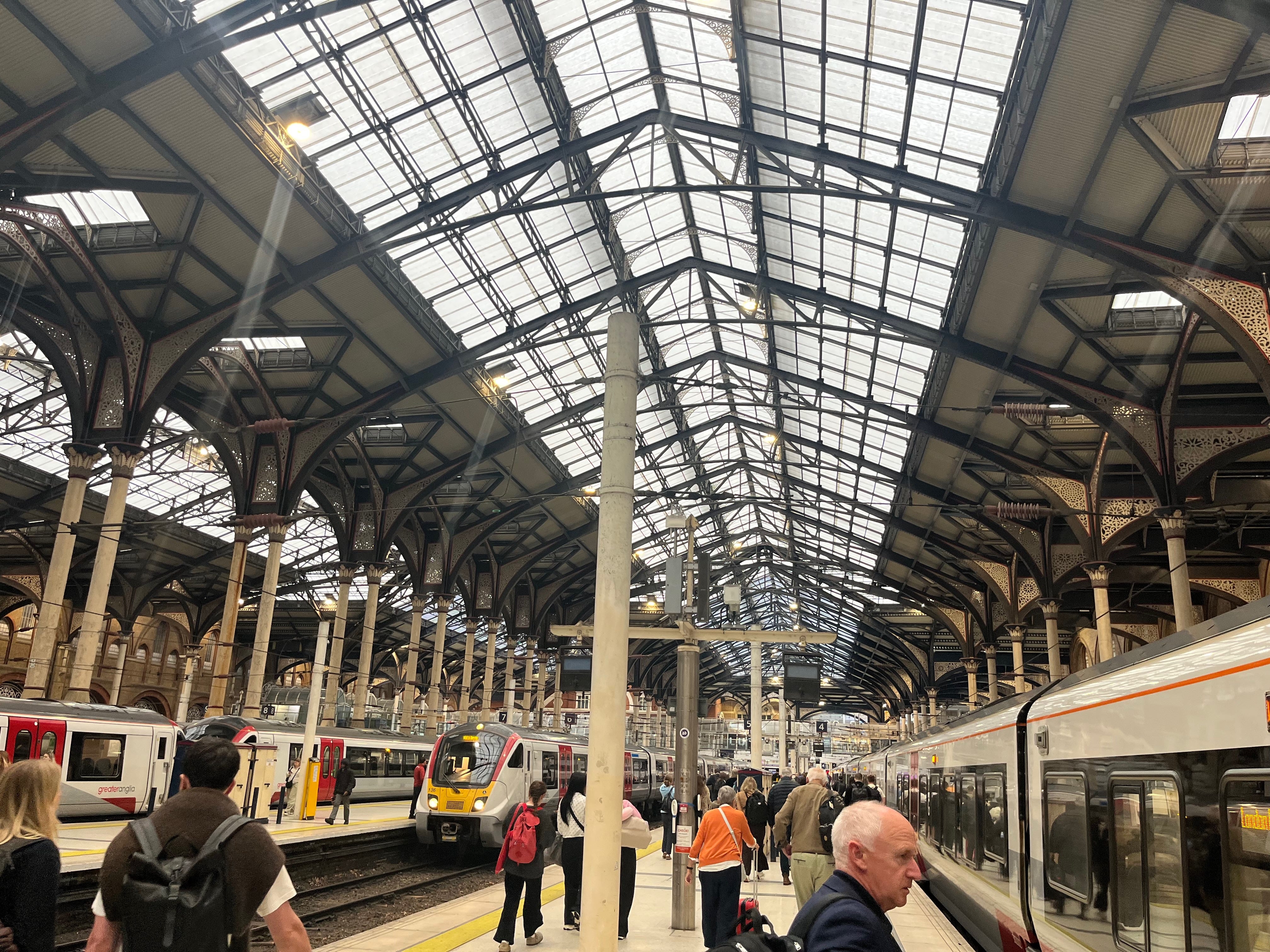
Liverpool Station
Londoners are a diverse bunch ethnically, drawn from all corners of the world, but the white people are pale, boast hairs sprouting in weird places (ears, adam’s apples, between their teeth), are racked and stooped and carry a general air of ill health. Not all of them of course– there are some ruddy young ones, some lads that look like they just came off the rugby pitch, or out of a scull on the Thames– but these are the statistical minority. It is June, but the sense of Northern Europe comes to me, after having just left the south. Nordic faces, the guttural inflections, blond hair. The smell of the bog. English being tonified with a lilt that makes my american accent seem anodyne; makes me feel like I don’t know how to properly inflect the blessed language as it clips through the lip trap.
If something doesn’t look right, the speakers keep saying, text the British Transport Police. They’ll sort it. See it, say it, sort it.
At Liverpool I waylay a station agent, get directions to the Elizabeth line. Avoid eye contact with a man looking for a mark. Get myself an Oyster ticket, pass through an electronic gate, into a white-tiled hospital hall. The sense of being subterranean pervades. I am following signage: make my way onto an escalator so steep and deep my body initially reacts to it the same way it did when I used to ski and came up to the edge of a run. Another snaking through corridors, labyrinthine bowels, another monumental escalator down.
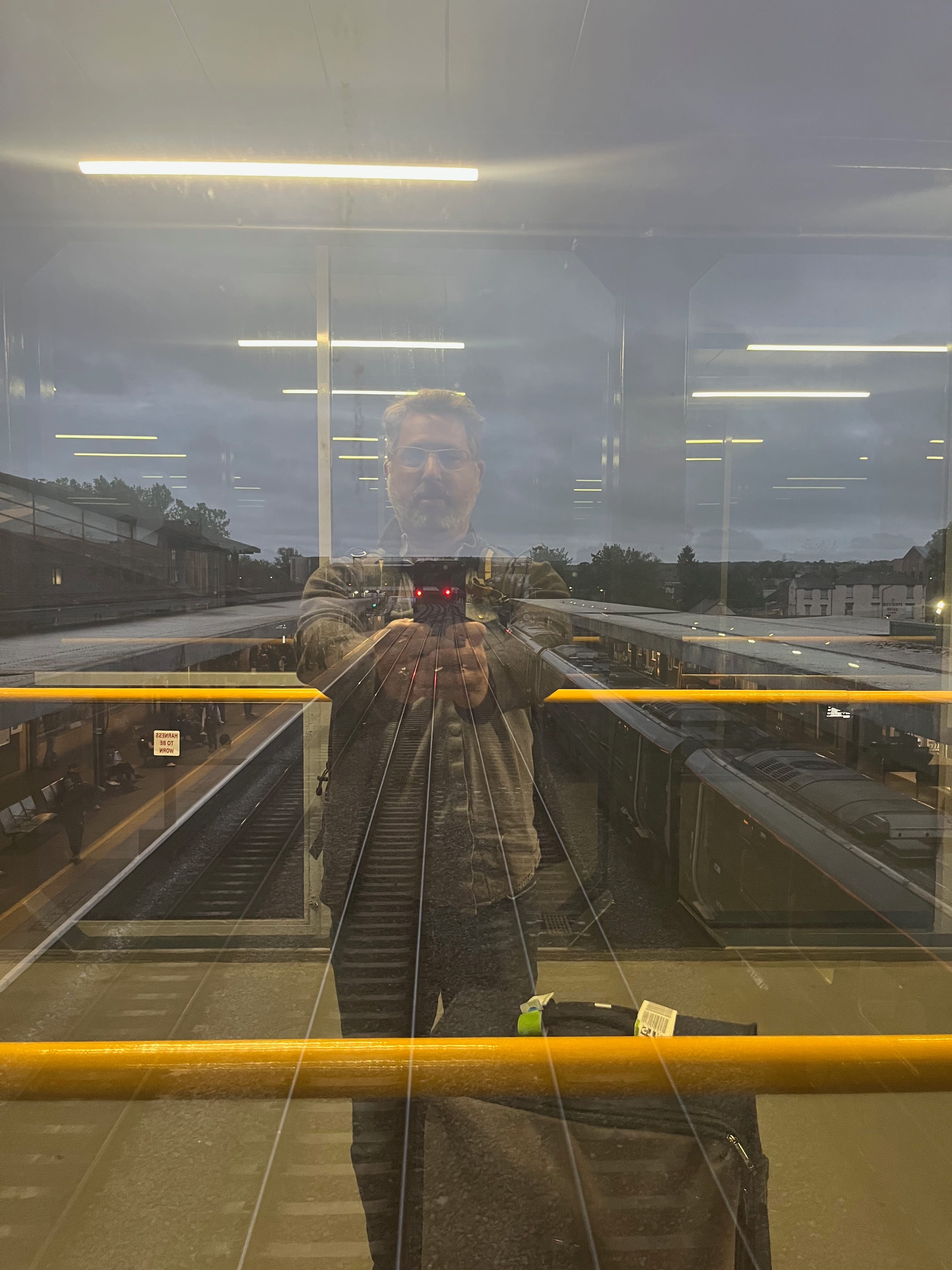
I reach the level of the train. At this point, by my own estimate I am a good five hundred feet underground. I don’t know if I’ve ever descended so far downward beneath the surface of the earth in something that wasn’t an immense cave. I take the train to Paddinton Station, make my way back up up up to the surface, again find myself in the vault of a train station. Buy a ticket for Oxford, pile into a train that will fill to the gills before it sets of west. I stand for thirty minutes until the first stop, sit down next to an Asian man staring into his phone, move to my own seat as the line continues. My host phones me. At Oxford Station I disemark, snap a disembodied selfie on the walkway above the tracks.