Moving Past the Polyvagal Controversy: An Expanded Clinical Framework for OBSERVING Autonomic State
A collaboration with Heather L. MacDuffie, PhD

I am pleased to announce that with research collaborator Heather L. MacDuffie, PhD, of Lifeworks of Maine, we have just released a preprint of a paper aimed at moving around the stasis in the Polyvagal controversy, specifically to aid clinicians and others utilizing Polyvagal Theory in applied contexts. If this is useful, please share it!
Rather than attempting to resolve the ongoing theoretical dispute, our paper identifies points of stability and utility within existing autonomic frameworks while examining areas where current models may not fully account for observable clinical phenomena.
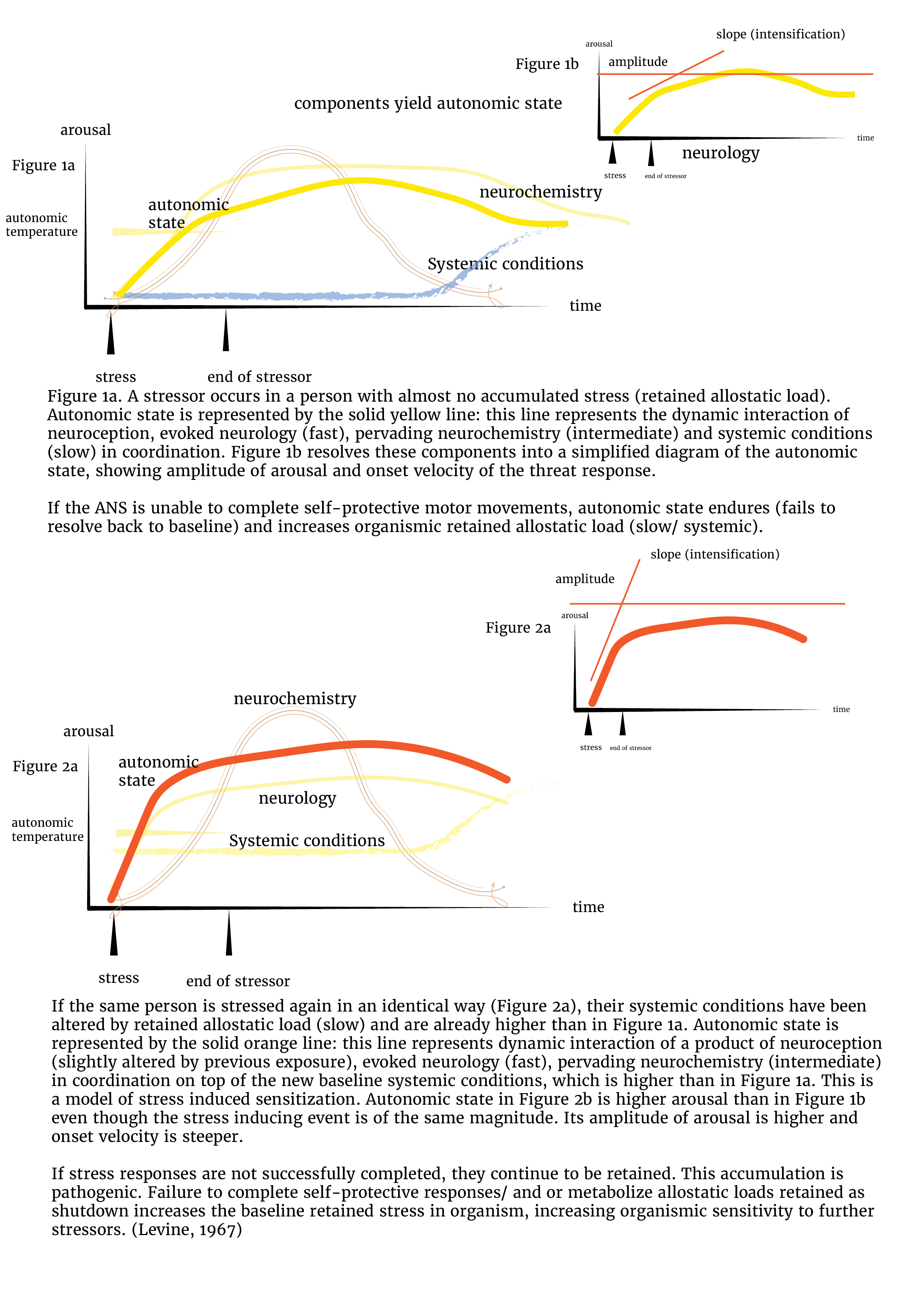
We move beyond the Polyvagal Theory two-variable (neuroception/ neurology) model of autonomic state to a four variable model (neuroception/ neurology/ neurochemistry/ systemic conditions) incorporating both fast, and slow processes (temporal dimensions of change) that more closely aligns with clinical observation.
We introduce a clinically grounded multi-modal observational approach to studying autonomic function in living systems, emphasizing the integration of interacting physiological signals.
ABSTRACT
Polyvagal Theory (PVT) has significantly influenced clinical approaches to trauma, development, and autonomic regulation by emphasizing the role of physiological state, social engagement , and perceived safety in shaping human behavior (Porges, 1995, 2007, 2025). At the same time, key aspects of the theory particularly its neuroanatomical, physiological, and evolutionary claims-have been subject to sustained critique (Gross-man & Taylor, 2007; Grossman, 2023; Grossman et al., 2026). Despite extensive discourse, this debate remains unresolved. This paper takes a pragmatic and clinically oriented approach. Rather than attempting to resolve the ongoing theoretical dispute , it identifies points of stability and utility within existing autonomic frameworks while examining areas where current models may not fully account for observable clinical phenomena. Drawing on in vivo observation and physiological tracking across clinical contexts, it proposes a multi-variable model of autonomic state that integrates neuroception, neural activation, and neurochemical and systemic conditions. It further introduces a clinically grounded, multi-modal observational approach to studying autonomic function in living systems, emphasizing the integration of interacting physiological signals.