

Paris
Musings from the TGV

I’ve been in France for less than 24 hours: right now I’m sitting on the TGV InOui, having just left the Gare Montparnasse. The train is moving south, picking up speed. Every time we go through a tunnel I wince slightly when the pressure changes in my ears. I don’t understand why no one else sitting around me is having the same reaction.
It has taken me less than 24 hours here to become convinced that Silicon Valley has ruined the world, and that the next generations of young people are fucked because of it. I’ve been in the international terminal at San Francisco International, on a flight across the ocean (the most endearing part of which was sleeping communally with about 400 strangers), into the terminal at Orly, down into the Paris Metro. During this entire time I have not seen a single person between the ages of 18 and 40 years old who is not on their phone. These might as well be appendages for the degree to which they are welded to the hands of young people.
I turned 50 a year ago, and I fancy myself a young 50, but the way I use a phone and the way that younger generations do reveals something about my own position at the edge of this demographic techno-phenomenon. I see this in my daughter, in twenty-somethings who look something up for me on their devices, even in my younger brother. There is a way that their fingers merge with the device, text without lifting a finger, pinch and squeeze and pivot through screens, that is dizzying to me, but is perhaps what others feel when watching me type. The interface I grew up with is a keyboard: I think that is what I’m saying. I pound keys that way that these screen natives navigate digital space; fingers flying.
It would be hard to argue that there is a more successful product ever created than the iPhone, if we are measuring both by adoption, and the velocity with which a product changed people’s behavior. In most public spaces I have been moving through, including Metro cars and now the high-speed train, people are on their phones, and an increasing number of them are jacked into earbuds, or wearing noise-cancelling headphones, which is also to observe that they are completely divorced from communal sensory inputs. With your face in your phone you are visually occupied: the second-order effect of this is that intentionally or no you are less available to conversation. Put in earbuds or put on headphones and the picture is complete. You register your unavailability pretty loudly. Of the four of us sitting facing two-by-two in this train cars chair set, two of us are wearing hoodies, which are a sartorial way of doing the same thing. You pull the thing up around your face and become completely socially unavailable. A turtle drawn into its own iPhone encrusted shell.
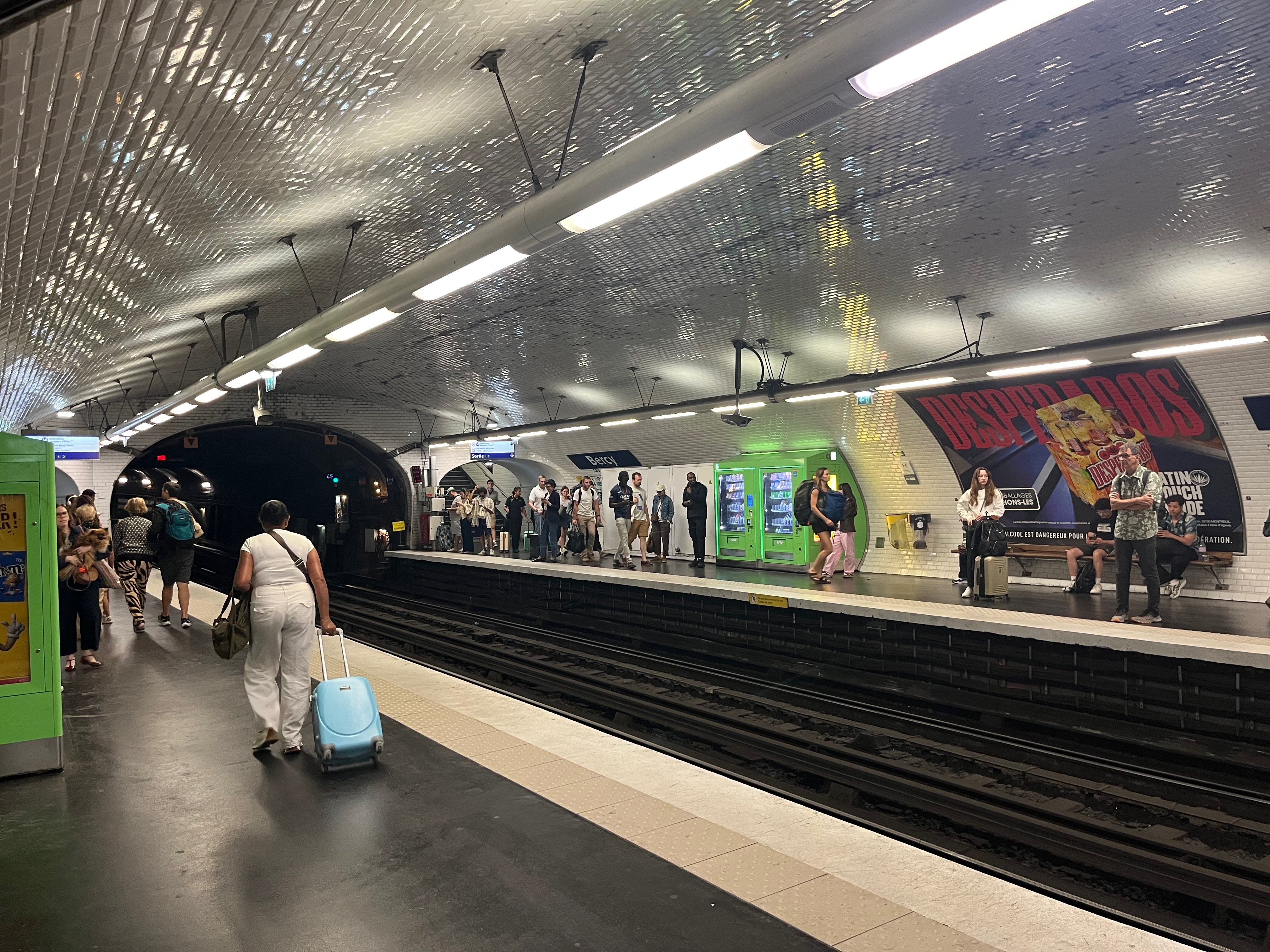
This is particularly on my heart and mind this morning because of an interaction I had at the hotel in which I stayed last night, with a handsome Tunisian man named Bilel with whom I struck up one of those rare conversations that you sometimes have with a complete stranger, premised partly on the recognition that you are unlikely to ever see one another again. On arrival at the hotel last night, he was kind enough to complement the broken French I am attempting to rescuscitate; this led to a slightly longer and amiable conversation about what I am doing in France. When I awoke this morning at 4 am, descended five flights of stairs in the hotel after lingering on the third floor to open a window out into the alley pre-dawn and inhale the still early morning air of Paris- the mansard roofs, an architecture replete with Hausmann apartments and their small terraces– I found him awake at the front desk; he had worked the overnight shift and if he slept there was no evidence of it. We walked back into the room that serves as a restaurant, where he made me an instant cappuccino and began to tell me his life story a propos of nothing beyond the fact that I was listening intently.
We talked for about an hour and half, during which he told me a story that would make a fine 19th century Russian novel. We spoke of his failed marriage, the courtship that preceded it, red flags he should have noticed, but did not at the time.
We entered someplace outside of the flow of ordinary time– an everywhen in which the details of this relationship, with a woman who was so deeply estranged from her authentic self that she simply became the woman he desired, until three weeks after their marriage when this constructed facade began to spectacularly collapse in the wake of his telling her about a nightmare related to the true paternity of the son that she planned to have with him penetrated into the actual underpinnings of the deceit, and exposed something from which she was unable to recover.
My eyes teared up, we traded stories, anecdotes, observations about life, failed relationships, heartbreak, what it means to leave a trace in the world through your actions…
I was not simply enriched by this conversation: it re-awakened the French language lying dormant inside of me basically since highschool. I had to make myself understood– I searched someplace inward oblique to my ordinary sense of linguistic awareness until the words surfaced in French such that we could understand one another. It was as if this unexpected friendship arising as suddenly as a flower in desert rain kindled the fire of the language that had been lying dormant in me for thirty years.
Had I taken a French-speaking or comprehension test prior to the conversation, and again after, I would have failed and then passed. This fortuitous social interaction was a byproduct of several things, but antecedent to all of them was the fact that neither of us was staring into a black mirror with our ears plugged. Does this moment of star-crossed mutual ensparkedness even happen for the generation plugged into their black mirrors? Are we becoming, through dependence on these black boxes, ever more alienated from the deep mystery of the effort to understand one another and be understood?
The degree to which smartphones categorically occlude casual conversation is not necessarily a feature of their design: it is more a feature of how they are used in society. Which is to say that it has become culturally acceptable to have them out all of the time. This cultural conditioning is not directly a result of the technology, but rather what I would term the cultural creep of them deeper and deeper into the domestic spheres of life, for there are (or have been) many kinds of technologies extant whose uses are dictated by social morays. For example– in most places it is considered impolitic if not illegal to walk around carrying a handgun, or set it on the dinner table next to your plate. You can easily imagine a society where it would be considered rude to take out your phone in the presence of others unless you were engaged in a defined task; where their utility was acknowledged, but their use was largely a private affair. But that of course negates the degree to which phones have a function that is quite obvious but rarely acknowledged, which is to say that they form a very effective social shield from exactly the kind of awkwardness through which we must pass to establish social connection.
I did not realize until I was in my mid-thirties, and formally studying connection phenomenology, how much practice is required to become a fluent conversationalist. What do I mean by fluent conversationalist? Essentially the ability to strike up a conversation with anyone you would wish to. You might ask yourself now, pausing as you read this – perhaps conversations around mating excepted, because I’m not here speaking about flirtation – whether or not you feel comfortable striking up a conversation with a complete stranger. Whether or not you have a habit of so doing? Whether or not you can tolerate the lapses in such a conversation that inevitably arise?
Does the thought of this inspire interest and delight, or does it raise your heart rate a bit with anxiety? The statistical answer to this, in the current generations of living humans probably tilts towards the latter, and so, guess what– If you are holding a phone in your hand you don’t have to. You could, of course, engage a prior generation of social cues to make your unavailability known– we can and do avert our gazes, look away, in general orient our attention to other places…put up a hand or other gesture of self-protection to make it known that we are not available if the subtler cues are not taken– I did this earlier walking with my bags to the train station when it became obvious that a slightly disheveled looking guy in an argyle sweater was going to ask me for money– but the lingua franca of the young is to evade all this nuance with the simple facticity of orienting your gaze into your phone.
Paris is a place where it is still a thing to kiss passionately on the street– I watched a couple in a lip-lock for a good long while last night, not out of prurient interest, but because they were doing this walking down the sidewalk and I didn’t want to collide with them – but I confess that I do wonder how the next generations will sustain the coupling required to maintain the population if we don’t know how to strike up a conversation with a stranger since everyone you know, outside of your immediate family, was at some point a stranger. At the risk of waxing strange, someone recently told me that in the future the population will crash because young people will prefer frictionless AI companions to inscrutable human ones. I would have laughed this off as lunacy a few years ago; I’m no longer quite so sure. The degree to which the current and next generation of LLMs can meld to your preferences, in a way that feels frictionless, like Scarlet Johansson’s character in the movie Her, which dramatized this scenario, makes me wonder.
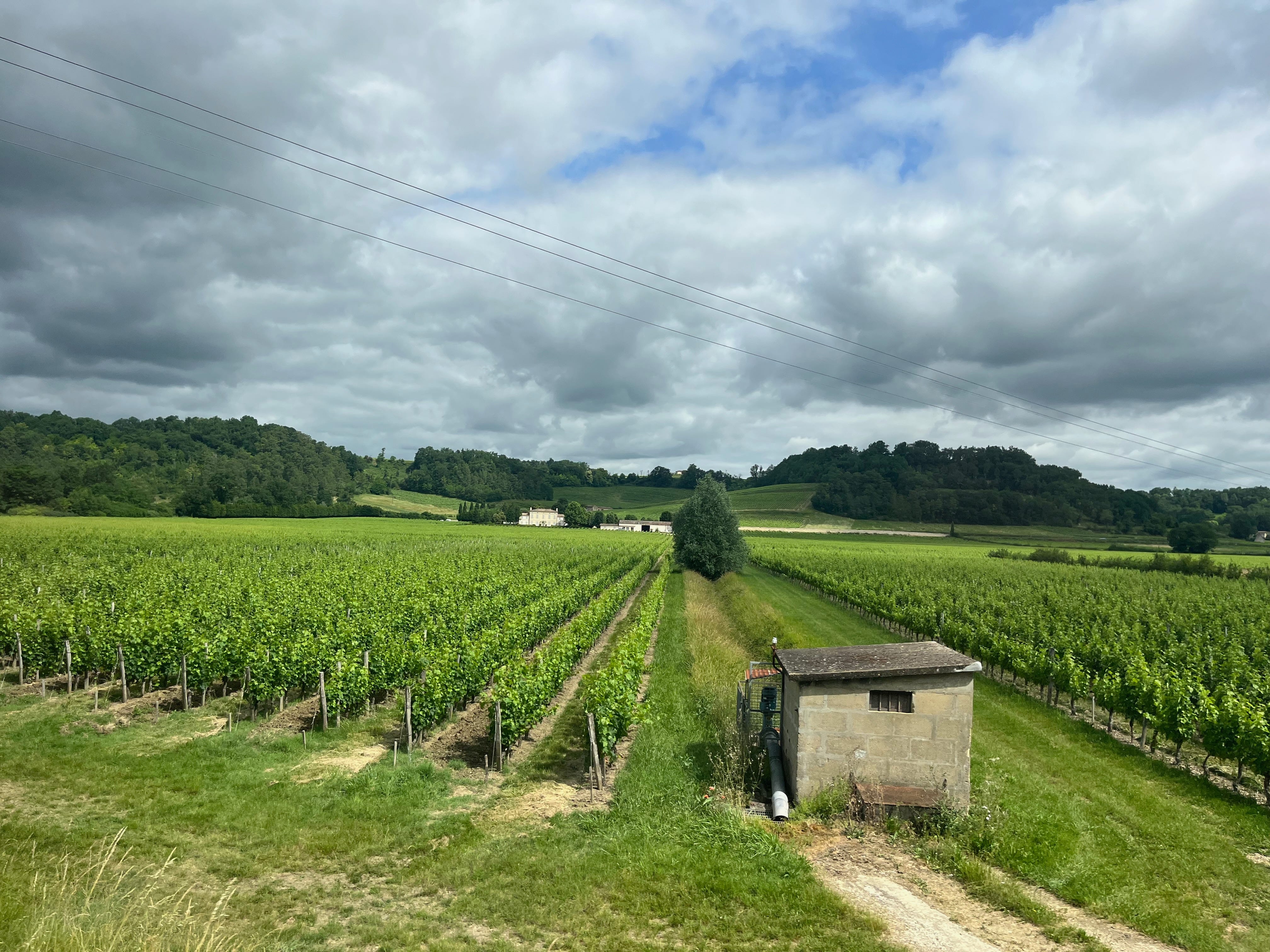
We are about fifty minutes south of Paris, shooting through a landscape that looks like rural Missouri, but with finer and more antique houses. We blow past tiny hamlets with peaked roofs and church spires, hay rolled in the fields. The stonemasons building these homes hundreds of years ago would never have anticipated that one day they would be passed by trains traveling in excess of 150 mph. Passing an 18th-century chateau at 200 miles per hour is something my body cannot quite make sense of: this juxtaposition between the temporal and visual realms of the historical and the modern. How are we to live simultaneously in all of these different temporalities? With access to the internet that can whisk us away to anywhere in the blink of an eye, where are we exactly? What does it mean to be rooted in place if our attention can leave so easily?
I recently had the experience on a flight of literally touching someone for two hours– he was overspilling his seat, during which he pretended that I did not exist socially. There was no acknowledgement, no greeting exchanged, no meeting of the eyes. We were two flesh cabinets who happened to be in physical contact, but were otherwise remote. This chilly reception on arrival precluded my instigating any sort of conversation– I thought, Fuck it, this prick is not going to look up from his phone. Likewise the two young people sitting opposite me are sharing an arm rest, his bare arm and her hoodie-enclosed arm within millimeters of touching. They look to be about the same age, both in their mid- to late twenties I’m guessing. In another era, a woman of childbearing age would not sit this close to a man she didn’t know (I’m not saying this is better, just different), but these two seem to be existing in the same non-acknowledgement I existed with my fellow plane passenger in for hours. The ride on the train is several hours, and the unstated yet agreed-upon subtext seems to be that we will all pretend that none of the others exist.
When the train conductor comes by to ask for tickets, I am astonished by her warm and sonorous voice. QR codes are registered, identifications presented, and then we are back to our screens. The large one of my laptop; the small one of their phones. Their will be no conversation exchanged in our block of seats: the most visual communication that arises a tiny nod of acknowledgement between me and the man sitting next to her as we take out our digital tickets. After he leaves she will turn away, look out the window, and weep, clearly about something that has nothing to do with any of us or the immediate moment. I will refrain from asking her if she is ok, since she has assiduously avoided my eyes as well and I do not want to intrude upon her privacy. This display of intense emotion, in the ambit of a city such as Paris, will make itself known and yet be contained entirely within the sphere of the private. And we wonder why people are lonely…
Within the next few hours I’ll be at a farm in countryside of southwestern France, where my next 5-day autonomic tracking retreat awaits…
There is still space in our retreat in Oxford (UK) June 12-14 should you care to come autonomic with us…
There is also space in our Northern Italy retreat in Civiasco (90 minutes NW of Milan) June 24-26.