

The Off-Axis Teahouse

Never was a dwelling lived in or constructed that was not a metaphor for the psyche. From the caves at Lascaux to the great cathedral at Chartres– a home for man, or a home for God– this notion of home is indistinguishable from what it means to be a self.
The story of modernity is a story of exile from home: Adam and Eve from the Garden, Cain from his family and the presence of the Lord. The story of Odysseus, titular hero of the Homeric Odyssey, another quintessential epic of the modern world, begins with him stranded by war far from home and hearth, and proceeds through the overcoming of insurmountable obstacles to make it back to dear Ithaca, his wife, son, and fireplace.
If the story of modernity is about exile, the story of our healing and wholeness is about coming home. Many languages have a word for this yearning for home: in the Greek of the Odyssey it was nostos. This yearning is the very engine of character, it is what drives the plot; the compass that orients action. It consumes Odysseus, and of his distance from home he is well aware. Most of us moderns are attempting another homeward odyssey, yet this one is inward, and I’m not sure how many people truly understand the cartography they are navigating or the compass they are navigating it with. It too is filled with seemingly insurmountable obstacles, with endless seductions and monsters, yet its cartography is neural, not geographic.
One place we can look for a clue about ourselves is our dwellings, because they represent who we are, what we believe we are, and what we aspire to be. They tell a tale. I am not a builder by trade, but I have designed several structures, and the one that I expended the greatest effort on by far, a film studio with an open wall deep in a forest, astonished me on completion by the degree to which it was an obvious stand-in for my own psyche.
On Bainbridge Island, a half-hour off the coast of downtown Seattle by ferry, is an extraordinary garden and nature reserve called the Bloedel. It is worth making a visit to the island for. It is named after the family that bought and enlarged the property: a timber magnate who was perhaps seeking some salve to the destruction he had wrought through the preservation of nature. The reserve manages to balance the primary tensions I find in all great art, which is to say a wildness verging on abandon counterpoised against a refinement of great precision. When a tree falls at Bloedel they are just as likely to let the trunk stand and get riddled with holes by woodpeckers as to leave it where it lies and let moss, lichen, and the roots of trees writhe all around it. One of my favorite spots in the place is the site of a massive treefall: several immense firs that toppled together into the lake and were left there, the gnarled mass of their root balls perpendicular to the ground, their massive bowing trunks smooth as some sculptural bridge diving into the lake, twinned in the water by its reflection. Standing there admiring the wildness of the scene I almost got struck in the head by a missile of a mallard winging down to land on the water: he came close enough to my face that I could feel the rush of air pulling off the back of his body: he whistled at me to yield as swerved to knife past my face.
This great wildness is balanced by painstaking precision. On a recent visit I watched a groundskeeper on a ladder hand-twisting single buds off shaped pines in the Japanese garden; another group of volunteers was on hands and knees removing twigs from the moss garden. I wouldn’t be surprised to see staff walking around with a chainsaw and tweezers. When I paint I use brushes as wide as your hand and as fine as a few hairs. The assault of beauty is full contact: I get it. Feral and sophisticated.
At the center of the property sits a villa in the Neoclassical style, perched on low cliffs above the water, as indifferent to its surroundings as any French chateau placed upon the west coast of the Americas would be, but it is not the primary residence that I want to tell you about: it is the Japanese teahouse. This teahouse wouldn’t be altogether out of place in Kyoto; the design is just so. You come upon it after a curve in the road, there is a stone walkway making its way through a shock of purple grass, then a gate, and then a rock garden in the Zen model.
The teahouse, which was originally created as a guesthouse, rises behind it. Coming around the side of it, after studying the texture of the walls– aged wooden slats burnished green by lichen– and the beams of which it is scaffolded: cylindrical logs carefully aged, incredibly straight, with not a visible crotch or knot I could find, I walked around the deck of it to behold the single most sublime garden view I think I’ve ever seen, as below.
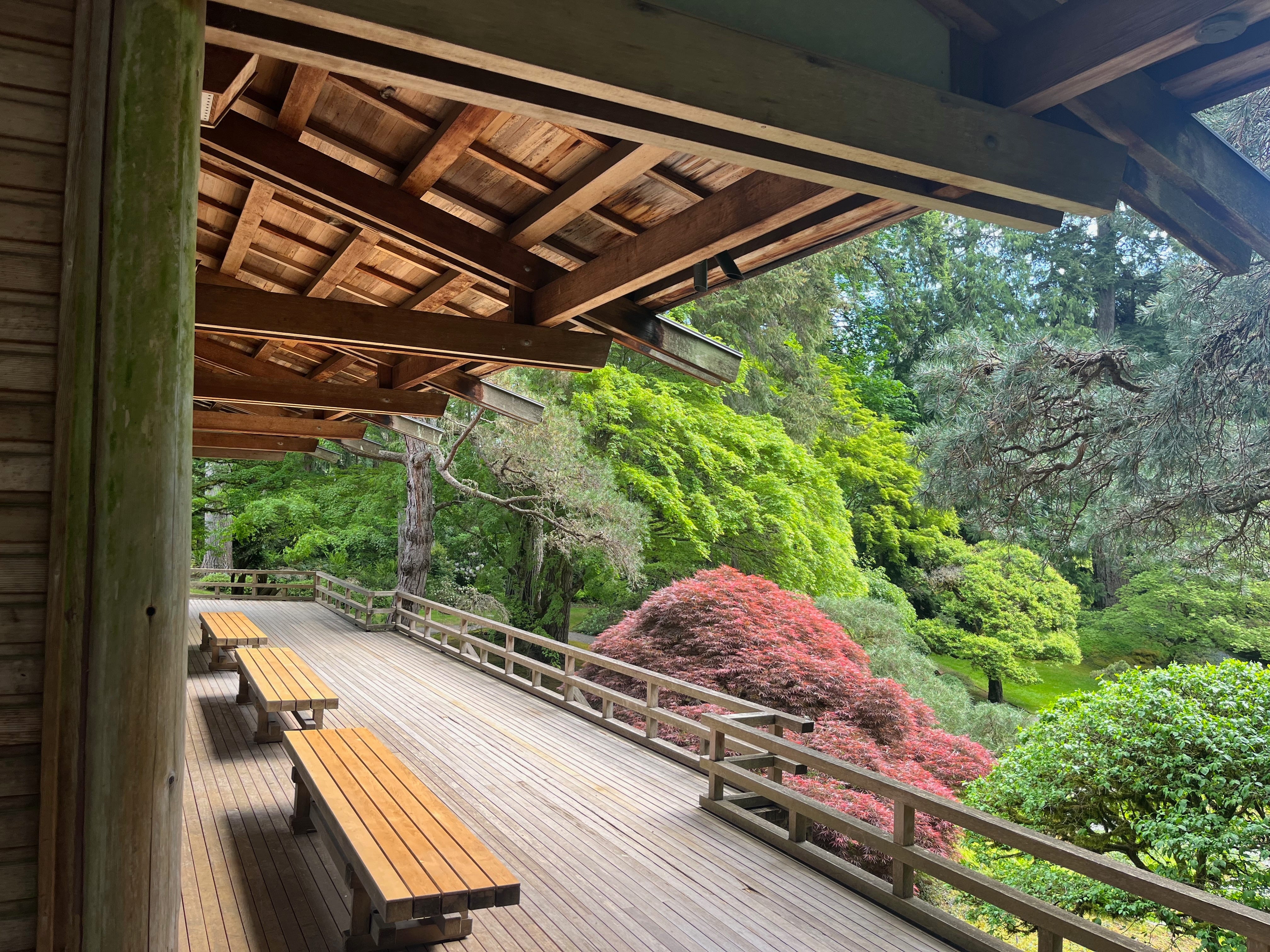
Before me were Japanese maples in crimson and fluorescent green, willows, ornately shaped pines sculpted to resemble clouds. The beauty and harmony of the scene was breath-taking: I was in a rapture. I walked in through the slatted doors on the side of the structure shaking my head, and dropped down several steps to the recessed main space, above which a chimney towered, and through which the forest was visible above: the central axis of the structure was entirely made of windows spanning the vault.
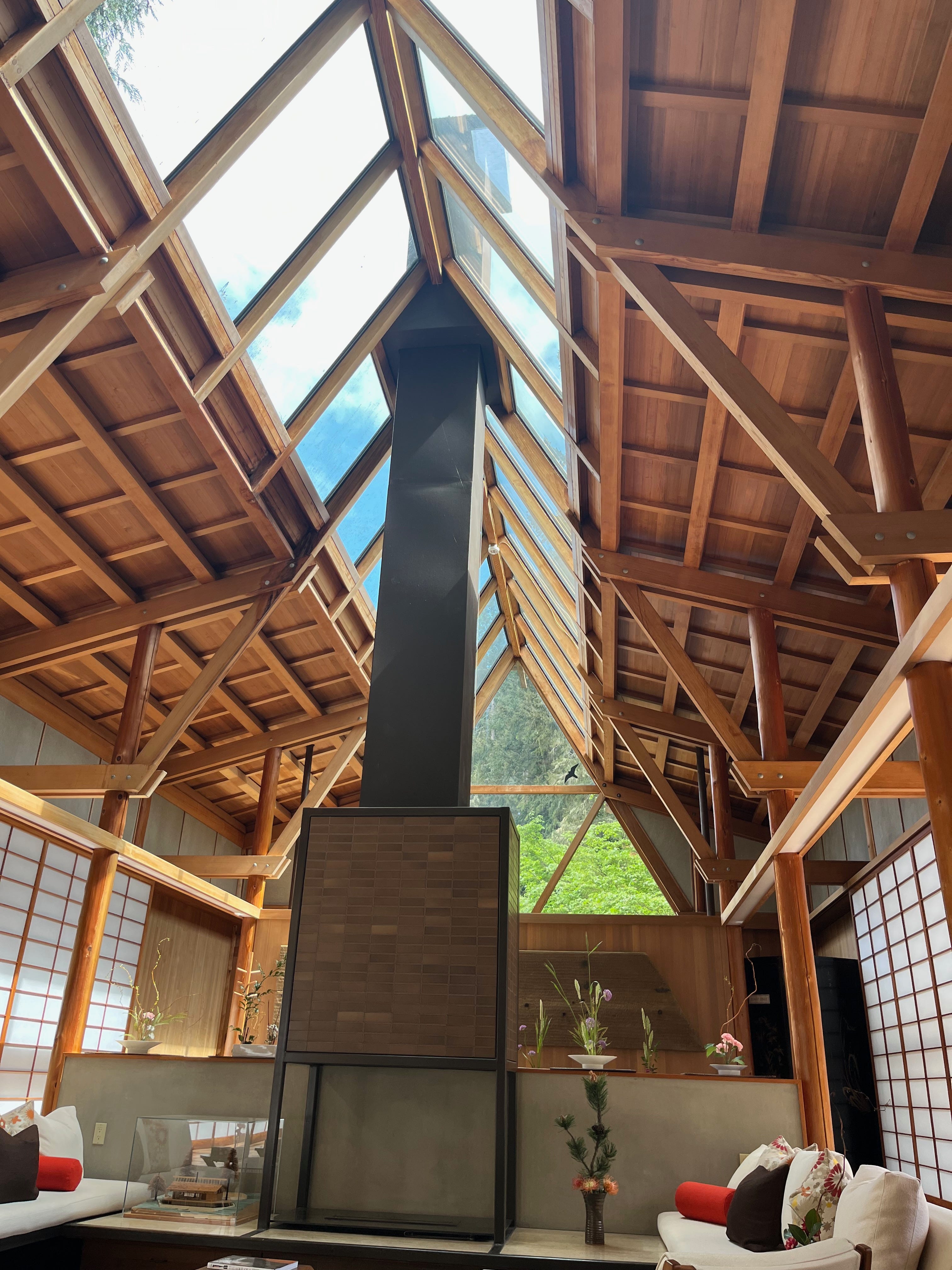
I stood there for a good long time, entranced, looking up. The simplicity of the building, its symmetry, the vault which registers the archetypal form of a sacred space to me, all of it was at the limit of beauty I have seen in a building in this world. I am no slouch in architecture, but this was nearly the most perfect structure I had ever had the pleasure of standing within. Its simplicity and beauty were unmatched. Each door perfectly framed the view outside: the rock garden on one side, the lake on the other. Here is the view from the interior across the lake:
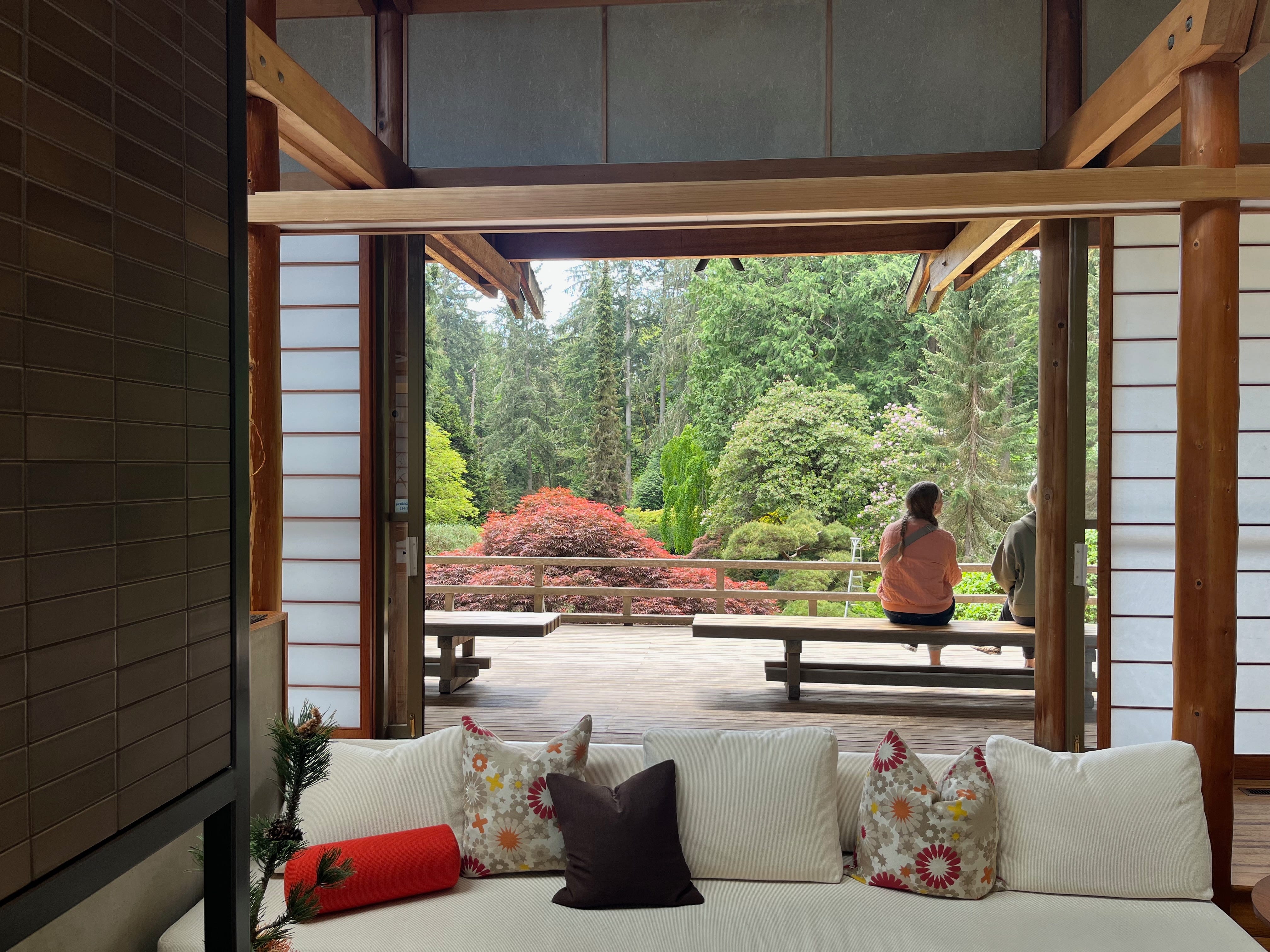
It was in this state of reverie that I stood up, overbrimming with appreciation, vaguely looking for someone with whom to share my enthusiasm – was there anyone around who was having the same reaction to this space as I was? – when I noticed something strange. Or, to put it more precisely, when my body noticed something strange.
