

Transforming the Epistemological Foundations of Autonomic Neuroanatomy
The Autonomics Foundation Papers

I want to elaborate on the paper that we published yesterday on ResearchGate, why it is important, and why you should take the time to read it carefully if you are seriously interested in our work.
Much of what I write is non-fiction. I was trained in writing at the creative writing department at Stanford University, and I write alot about autonomic physiology here, and in my books, in a way that I hope brings some of who and what I am personally to the conversation, such that why it matters registers. Yet for our work to assume its proper place in the fields of medicine and mental health, so that there is effective systemic uptake and it support human flourishing at the level it can, it has to be properly established in the research literature.
For the past 15 years we have been pursuing a radically different approach to understanding the autonomic nervous system that is based on interoceptive access to its living moment-to-moment dynamism, and that dramatically refines the autonomic cartography of the ANS, in its peripheral localization in the body (as in outside of the brain and spinal cord), which has been systematically neglected in the field. Better maps lead to more refined intervention. Corrupt maps prevent effective intervention. There are fundamental hitorical and methodological reasons why the methods through which classical neuroanatomy mapped neural structure necessarily fail to map the fine fiber network that comprises much of the living ANS.
As many of you likely know, I collaborated with Stephen W. Porges, PhD, for five years, during which time I wrote and art directed the Official Polyvagal Poster (with advisory review by Deb Dana), interviewed Steve a number of times, and participated in trans-disciplinary research dialogues organized by David Hanscomb, where I was in dialogue with Bob Naviaux MD PhD, and Ruth Lanius MD PhD among others.
Shortly into the process of creating the Official Polyvagal Posters, in 2020, it became patently obvious to me that the received neuroanatomical maps off of which Porges had built PVT, and on which modern autonomic neuroanatomy rests, were fundamentally flawed.
Over the last six years, this has played out like a detective story. My intuition in 2020 was that multiple aspects of the peripheral autonomic nervous system were recognized anatomically without being understood physiologically. One of my first intuitions of this was with respect to the celiac plexus; soon it became obvious that the nucleus ambiguus was the same. In both cases, specific medical and or neurological disciplines had distinct, particular, and non-aligning descriptions of what the neurology actually did that were siloed deep with the particular disciplines’ literature, and contradicted one another in obvious ways. Each discipline seemed to understand the neurology’s importance relative to its particular scope- if you ask an ENT surgeon about the functions of the nucleus ambiguus’ they will describe it in a way that does not align with what a Polyvagalist will tell you. If you ask a practitioner of Visceral Manipulation about what the celiac plexus does, it will not align with what a gastroenterologist tells you.
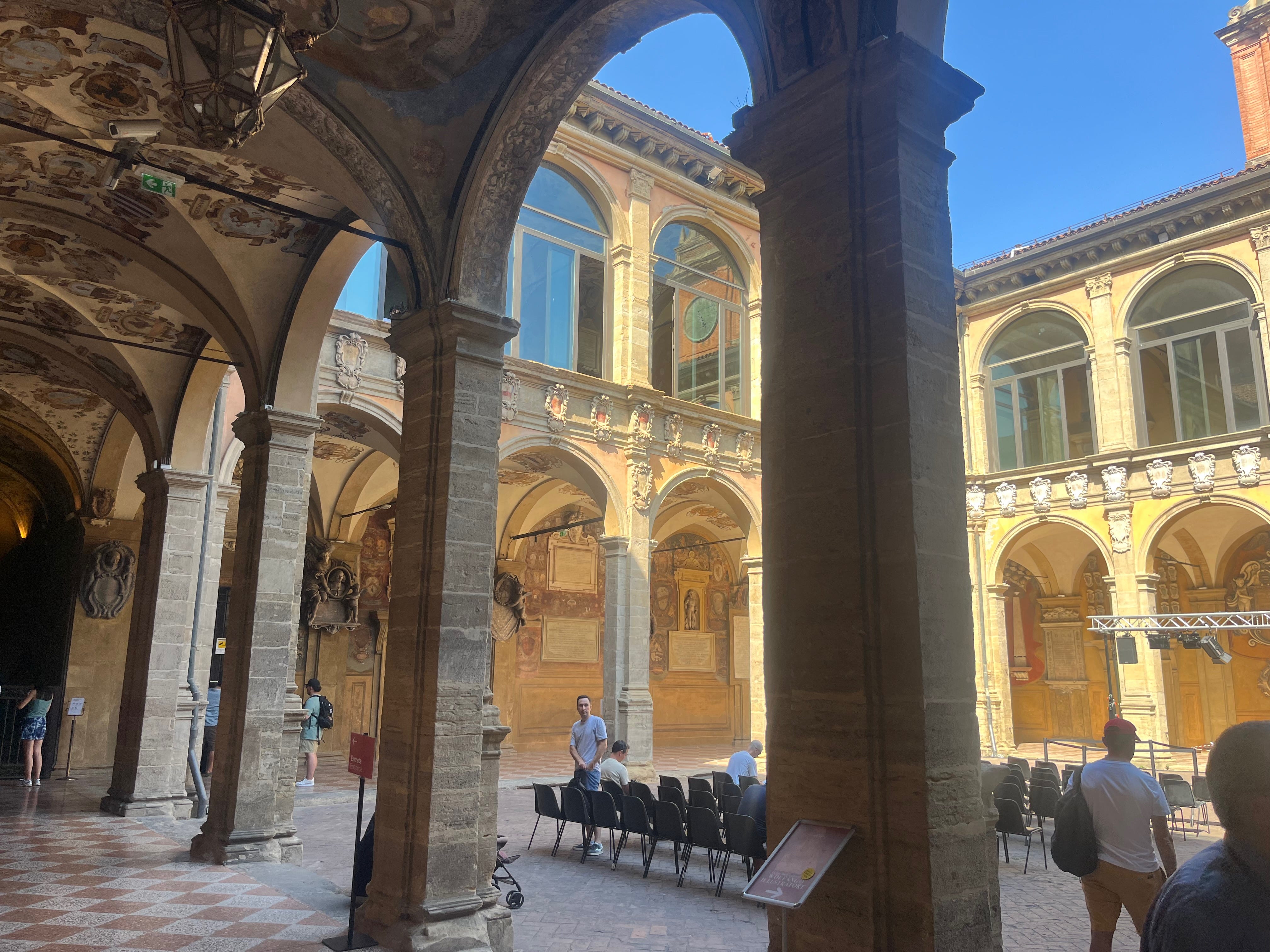
University of Bologna, where I was viewing the most famous dissecting theatre in the western world
Slowly, over the past six years, we have assembled clues…At a certain point in 2023 we jettisoned the received maps entirely and began working with an entirely different methodology, which I have described as autonomic tracking. Where this contradicted either the received mainstream neuroanatomy, or Polyvagal Theory, we studied to see a) was the deviation replicable across a variety of individuals clinically, b) was there some potentially methodological or historical explanation for the variance, c) was there some potentially neuro-developmental explanation for the variance.
In June of 2024 we completed the new foundation model of the living ANS.
This new cartography, in combination with autonomic tracking as an emerging clinical approach, has led to significant breakthoughs on the clinical side (we have successfully resolved, at this point, dozens of specific neurological cases that allopathic medicine insists cannot be healed), that are and will continue to unfold.
In June of this year, in Europe, I conducted several clinical sessions that revealed a sequential ignition architecture in the Autonomic Nervous System that seems to be the set of cascading initializations whereby the by fetus transitions, through birth, from a marine animal to a terrestrial animal.
Take a moment to consider how massive and strange this transition actually is. A fetus is neutrally bouyant (effectively outside the field of gravity), externally pressurized by the intrinsic limitations of the size of the womb, fed air and nutrients through the belly. Upon birth, the a) manner in which the heart works transforms on first inspiration of breath, the b) lungs inflate for the first time, c) the body is now breathing through the face rather than the umbilical cord, d) the body now ingests through the mouth instead of the umbilical cord (essentially these transitions migrate ingestion and respiration from your belly to your face), e) the body has to inflate the vascular beds to pressurize (blood pressure is intrinsically necessary, because only if the body is internally pressurized can blood be pushed upwards against gravity to the cranial brain, which is extremely sensitive to oxygen levels). All of this happens in the first minutes and hours after birth– and seems to be profoundly depending on the ambient neurochemical context, and specifically oxytocin levels.
It seems to be the case that this initialization sequence does not necessarily complete for everyone at birth, and/or elements of it may remain incomplete.
Witnessing this has, literally, totally blown my mind. Like, my jaw is still on the ground.
I started to write a research paper about it shortly after the experience, but realized that in order for this to be received in the correct way, I needed to write a series of antecedent papers to explain the ideas that preceded it, and out of which it emerged, otherwise concepts that I am taking for granted in the paper will be misconstrued. As I worked backwards - what needs to be established prior to this paper - a chain of papers began to organize, and to this end I am writing a series of Autonomics Foundation papers.
The first one, which sets the historical epistemological context, is what we published as a preprint yesterday.
Over the next several months I will publish the series of papers, initially as preprints while we seek peer-review.
In July and August I am going to teach several advanced classes directly on these themes, which can be viewed as a mini-series at the cutting edge of our work. These take place Saturday mornings 8 to 11 am Pacific time.
July 25- Autonomics of Breath
August 8 - The Perinatal Autonomic Cascade
August 22 - The Tonic Labyrtinthe Reflex as a General Purpose Vestibular-Proprioceptive Recalibration Mechanism
If your mind is not blown I will be very very surprised.
Part of the reason I am in Europe is to conduct the keystone 5-day trainings that conclude our yearlong autonomics practicum. Our plan is that these will take place in Europe annually going forward.
There is still space in our Yearlong Autonomics Practicum enrolling September 2026.
We have two cohorts, one in the morning in the US and Canada, one in the afternoon. These are timed for practitioners in Europe, and in Asia respectively.
The first step in that process is the application, which is here
If you do read the paper on Research Gate, please let me know what you think. Comments are open for all subscribers, free and paid.
Very exciting!