

What is the nervous system? 🤦♂️
Nervous System basics


nervous system as inward forest…
In a group about ‘Healing the Nervous System’ on Facebook, someone asked a question recently about what the nervous system is. There were more than 20 responses to this question, all of them partial in some way. Some of the responses were accurate, some of them were 🤦♂️.
In the context of 'healing the nervous system' much of what people are talking about is healing the Autonomic Nervous System, the central conduit of which is the vagus (10th cranial) nerve.
But let's start with what is the nervous system at all. If you take a neurobiology course at most universities, you would begin with studying the individual unit of the nervous system, which is a neuron. But this isn't necessarily the most useful place to start thinking about what the nervous system actually is.
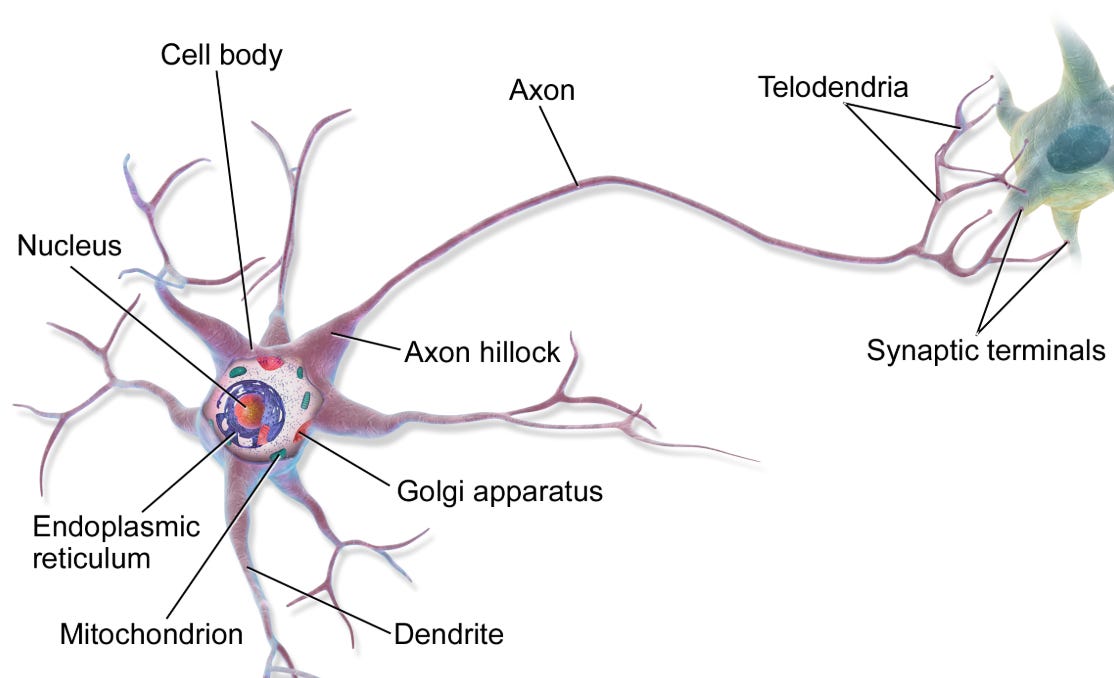
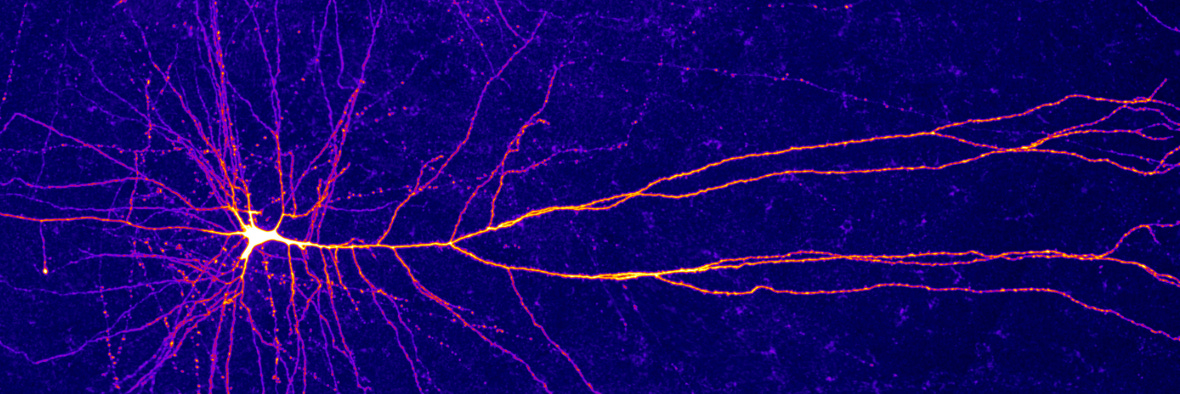
scanning electron micrograph of a neuron
In an adult human body there are approximately 30 trillion cells. Each one of them is, in its own way, a tiny world. Yet they have to cluster and function together. The body is, in a way, like a murmuration of starlings: a swarm of trillions of cells that has to move together and coordinate closely. The body has multiple ways for doing this, but the most comprehensive rapidly coordinating internal system is our nervous system. It is the communications infrastructure for the body. Both inwardly (inernal milieu of the body) and in relationship to our environment.
This system communicates electrically.
When neurons develop, they are a lot like plants. They grow from a source to a target. A plant grows toward sunlight. Neurons grow as they are used (attention is the sunlight). Nerves are linked chains of neurons. They bundle and cluster together in pathways in the body. Neurons cluster and cross-talk. The largest cluster is the cranial brain. But there are neural clusters distributed throughout the body, in the heart (neurocardiology), in the gut (enteric brain), in the pelvic floor, up and down the spine (sympathetic ganglia) and in other places: they are called plexes and ganglia.
Traditional neurology has been highly focused on the brain in the head because modern people tend to identify self with thinking. In a world where 'I think, therefore I am' we have given pride of place in our neurology to the structures where thinking takes place in words and images. Yet there is an important counter argument to be made, which is that 'I feel, therefore I am.'
Cells are designed to feel. From this perspective, sensitivity is the root of our intelligence. The embodied neural architecture of feeling is sensory. The part of the nervous system that senses our interior is the autonomic nervous system. When people are talking about 'healing the nervous system', this is the part of the nervous system they're generally referring to.
You can think of autonomic as automatic. In other words, this is the part of the nervous system that we don't have to consciously control. It beats our hearts, breathes, governs our immune function, digests our food, regulates body temperature, controls the arterial and venous flows of blood in the body. It is responsible for homeostasis.
Yet the world is also waking up to a second crucial function of the autonomic nervous system. Based on our present moment detection of safety, danger, or lifethreat, the autonomic nervous system surfaces energy processing templates that tune our bodies and minds to respond to the environment. If we feel safe enough in the body- and this is not a detection made by our thinking or our ordinary sense of self- we can coordinate various aspects of our autonomic nervous system, and create the conditions for health, growth, and restoration.
Yet if the body finds itself in danger, it re-tunes into defensive states. This capability is necessary for survival. If there is an emergency, the body sometimes needs to mobilize tremendous amounts of energy to respond. These defensive responses allow us to do all kinds of incredible things. In extreme cases, we can jump fifteen feet to get away from a crocodile, or lift a car off our toddler. The problem happens when these defensive responses become chronic or non-revolving, because these are very energy-intensive responses.
There are two primary categories of autonomic defensive response. One of them is a mobilized high-energy response which is commonly called fight-or-flight. This is what most people think about when they imagine stress. The other is an immobilized shutdown response.
If people experience chronic defensive states in early development, because their environment was not safe, their caregivers were not attuned, etc., and cannot shift out of them, the accumulated stress of these responses is retained in the nervous system, body, and brain. We retain stress neurologically and neurochemically. It also changes predictive properties of the cranial brain. This is generally called 'trauma'.
Healing the (autonomic) nervous system then is about several things. It is about familiarity with this embodied autonomic nervous system that communicates through sensation, emotion, and meaning, and is not our ordinary sense of self.
It is about understanding that our survival responses are stronger than our cognition and learning to be in our bodies with grounded sensitivity (which is to say grounded intelligence).
It is about learning to change the neurological inputs to our systems to give us greater experiences of safety and connection so that we feed these deep systems nourishing inputs. These include the rhythmic inputs of the natural world, healthy relationships, etc.
And it is about learning to transform residual stress responses that have accumulated in the body.