

What 'There is No Such Thing as a Primitive Reflex' Means
What it Means, Why it Matters

In which I will now translate the abstract of the paper published yesterday (THERE IS NO SUCH THING AS A PRIMITIVE REFLEX: Restructuring Reflexes as a Distinct Category of Hardwired Autonomic Calibration) into English and explain why it matters.

One of the foundational yet distorted premises of the modern world view is what I tend to refer to as ‘the hegemony of visuality’. Broadly construed this is to say that people tend to believe things they see are real. We tend to equate seeing something with understanding it. This is a linguistic as well as a cognitive phenomenon. When someone says, “I see what you’re saying,” they don’t literally mean they see the words: they mean they understand them.
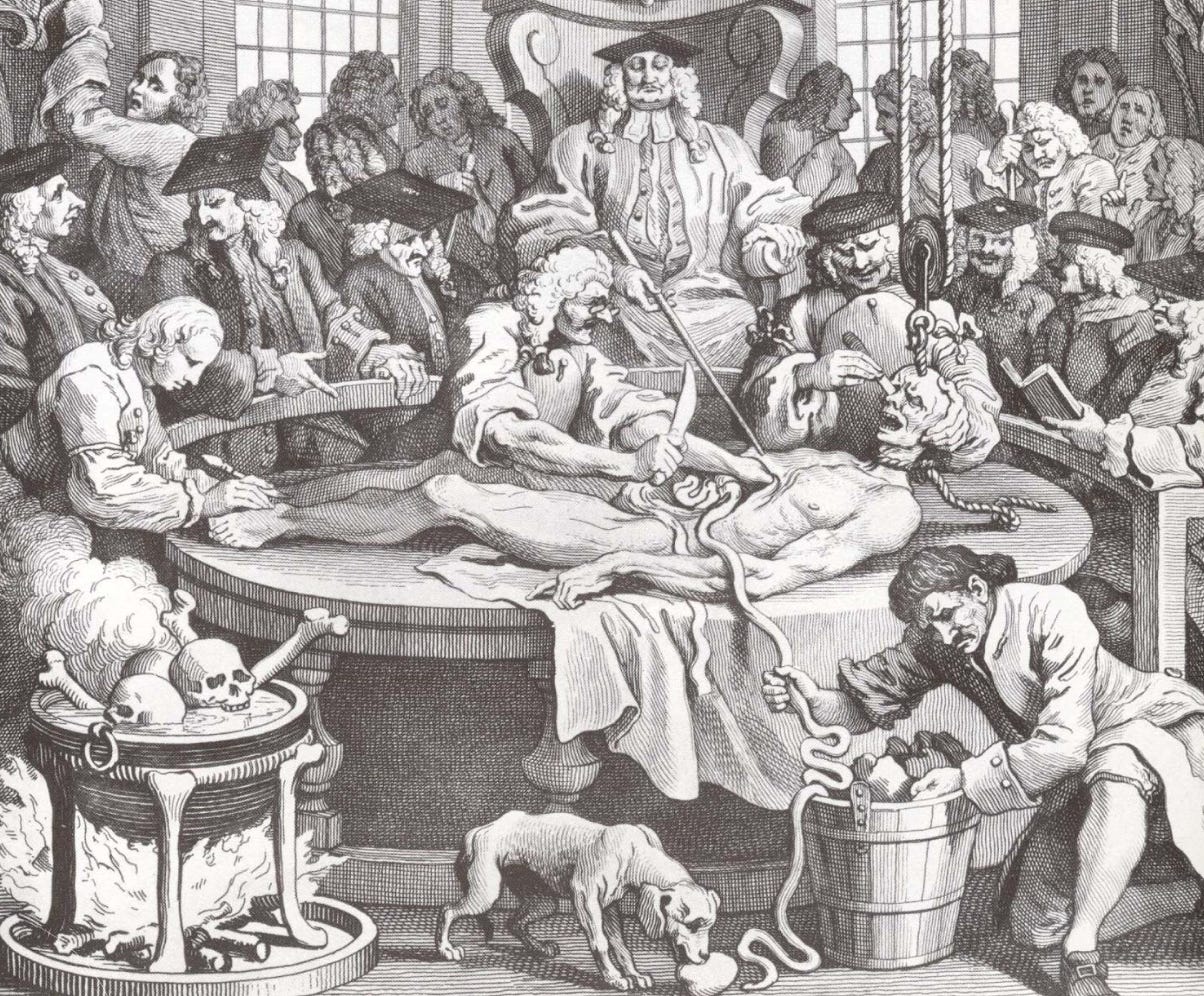
The history of modern neuroscience is filled with scientists mistaking things they see for reality. The most astonishing failure to distinguish a visual artifact from how the nervous system actually works is the division in classical neurology between the brain and spinal cord. There is no functional division between the brain and spinal cord. Yet there appears to be if you are an anatomist looking at it in a cadaver. The brainstem exits the brain at an opening called the foramen magnum: an oval hole in the bottom of the skull into which it coordinates with the vertebral column. In the cadaver, the brainstem and spinal cord present as two visibly separate structures: the brainstem sits enclosed in the skull, the cord descends through the vertebral column, and the opening at the skull’s base creates a visible architectural discontinuity between them, reinforced by a narrowing of the cord at that point.
To a dissecting eye working under the conditions available to classical anatomists — poor lighting, no microscopy, no histochemical staining, and dissection preceding the Neuron Doctrine entirely — that kind of visible discontinuity was the only reliable signal available. “I see a boundary between these two structures,” declares the dissecting anatomist. “Therefore, a boundary exists.”
A clear structural break like the foramen magnum registers as exactly the sort of landmark early anatomists rely on. The problem is that this is a boundary in the skeleton, not in the nervous system. The brainstem and spinal cord are, crucially, continuous neural tissue — there’s no neuronal juncture at the foramen magnum, no point where nerves terminate and restart. What the classical distinction actually tracks is where the skull ends and the vertebral column begins, not where one neurological system ends and another begins.
Yet this false distinction has been baked into neuroscience ever since. What is the Central Nervous System? Brain and spinal cord. A non-sensical statement since the spinal cord is the same part of the nervous system as the brainstem. This illogic has infected then every neuroanatomical model built since, up to and including Polyvagal Theory.
The broader pattern: from the outside looking in (situating ourselves in the location of the anatomist gazing into the body into which we are trying to break) the way things appear becomes the fulcrum of attention and discernment. The visual artifact becomes the very thing studied– because we can see it – even if it is not the actual phenomenon, or even if it is ancillary to the phenomenon.
Because we have culturally reified a worldview and ways of knowing that occlude the possibility of a reliable subjectivity, preclude the possibility that things can be known and sensed and felt accurately from within themselves, that an organism can know its own inwardness in quantifiably accurate ways, the field entire has organized around ‘looking in from the outside’.
This perspective informs not only our anatomy and neuro-anatomy, but the interventional landscape. Because we do not understand that we can non-invasively change input signals to the afferent vagus, the state of the art involves putting a bolt of electricity into someone’s neck (vagal stimulation) a technique that we will look back on in fifty years and classify in about the same territory as attaching leeches to a patient to balance their four humors.

There is no such thing as a primitive reflex, because what we are seeing, and naming as a ‘primitive reflex’ is the visible output motor signature of an inward autonomic calibration the function of which modern medicine, physical and occupational therapy, and developmental neuroscience do not understand.
There has been no teleological – what is the purpose, goal, or ultimate end - inquiry into what function these reflexes serve in terms of organismic calibration or development. There is not even a category in the taxonomy of reflexes to ask this question. This is a bit like listening to the intestines from outside, watching peristalsis, and declaring that digestion is the patterned contraction of the smooth muscular walls of the intestines. What does this description miss? Nearly everything that digestion is: namely its function and what it is actually doing. It describes what you can see from outside; not what is happening.
The current descriptive taxonomy - primitive reflexes - is the visible surface phenomena absent the entire meaning of the act.
Now we understand what that visible surface phenomena is in service to: organismic calibration of the newborn from a neutrally buoyant marine environment to an air-breathing, food-eating, terrestrial mammal locomoting in the field of gravity. The two new papers - The Perinatal Autonomic Cascade: A Sequential Model of Neonatal Autonomic Initialization, and yesterdays’ THERE IS NO SUCH THING AS A PRIMITIVE REFLEX: Restructuring Reflexes as a Distinct Category of Hardwired Autonomic Calibration answer the deeper unasked and foundationally important question: what the visible surface means.
They also provide a broad corrective, because if the reflex is the visible output signature of a deeper autonomic ignition or calibration, creating interventional strategies that target extinguishing the reflex in the absence of that functional goal completing would be – well – not useful.

I’m teaching this new research over the next month. Learn more here. View the Hearth Science research program in its entirety.

My first writing about the nervous system for the Psychotherapy Networker should be available by the end of July. My first article, Separating Signal from Noise in the Polyvagal Controversy, addresses the history of Polyvagal theory, the Grossman Controversy, the Porgesian refusal to engage, what is actually being contested in the debate, what part of this matters, what part of it probably doesn’t, what is crucial to hold onto from PVT, what probably should be dropped, and what you can do about it all…more details when it publishes.

Doing research in Bologna in June I visited the Palazzo dell’Archiginnasio e Teatro Anatomico, an 800 year old dissection theatre at the University of Bologna. A literal theatre– a forum for the gaze: hegemony of visuality as truth-seeking mechanism.